Tuesday, September 10, 2013

DBC Swift Test Ride

Last night we stopped by DBC City Bikes (formerly the Dutch Bicycle Company) in Somerville, MA to have a look at their new "Swift" line of bicycles. DBC - whose focus was previously on importing Dutch and Danish transport bikes - has now changed direction and established their own line of classichandbuiltbicycles. The Swift models are designed in house by Wentworth and MITgraduates and built to spec by local framebuilders. They had a few floor models at the shop, and I test rode the loop frame ladies' version.


The Swift is TIG-welded cro-moly steel.The build includes upright handlebars, Brooks saddle, internally geared hub, front and rear drum brakes, dynamo lighting, fenders, chainguard, rear rack, and a cafe lock.The curvature of the top tube is executed nicely, and the welding is very clean. There are no dress guards, but nowadays it is becoming easier to purchase those separately. The lack of a full chaincase could be problematic for those who want one, but others would consider the chainguard sufficient. Everything else you might need in a transport bike is included.

As always, I am not a fan of unicrown forks, but at least the welding here is nice and neat. The fork blades are curved. There are cable routing guides for the lights and brakes. Not sure how they are attached - they do not seem to be braze-ons - and why they were made in a contrasting colour.


The dynamo headlight and tail light are custom: DBC fitted what I think might be SunLite casings with LEDs and turned them into dynamo driven lights with a standlight feature. It's a neat system and the lights are very bright.

Tail light. Front and rear hubs are Sturmey Archer. The bicycle I test rode was a 3-speed, but they are also available as single speeds and 5-speeds.


The fluted fenders look like VO to me. The wheels are 700C.


The pedals are attractive and grippy, but it is a trade secret where they are sourced from! (Anybody happen to know?...)


Riding the DBC Swift was a very particular experience. In many ways, it handles like a classic Dutch bike (think Gazelle or Batavus, as opposed to Pashley or Velorbis), but is lighter and more responsive. The angles are steeper and other aspects of the geometry are a bit different, but still - all in all the Dutch bike qualities seem to dominate. In the picture above, you can see how tall the headtube is and how high up the handlebars are - almost at my chest. The resultant sitting position is bolt upright.


I was not sure what to expect, but I have to say the ride quality was nice: smooth, peppy, lightish, and with an easy feel to it. The bike is stable and easy to control. When my hat flew off my head, I caught it while continuing to cycle; the bike seems fairly klutz-proof. Another notable aspect of the bike, was the superior functionality of the drum brakes. All other drum-brake city bikes I have tried or owned were fitted with 70mm version, whereas DBC fitted the Swift bikes with the 90mm version. Especially for the front brake, the difference in braking power is substantial.


According toDBC, the Swiftis meant to be comfortable and non-intimidating even for those who are new to bikes. In this respect, I think it is a success. At the same time, it was designed to be more maneuverable in traffic and easier to ride uphill than a Dutch bike. In this regard however, I am not sure that it feels much different from my traditional Gazelle. It is definitely lighter and somewhat more maneuverable, which some consider a plus for American streets. But it did not strike me as necessarily "better" than my Gazelle - on which I handle traffic and the local hills just fine. It seems like a good bike though, and whether one would prefer it to a traditional Dutch bicycle is a matter of personal taste - just as whether one prefers lugged vs welded frames.


As I was riding the ladies' Swift, the Co-Habitant took a spin on the men's version. I should note that the men's and ladies' versions of the Swift are completely different bikes, designed by separate teams. The angles are different, the proportions, everything. So while my experience of the ladies' model was positive, I have no idea how the mens' handles, and the Co-Habitant's feedback was vague. When it comes to city bikes, I think he is a creature of habit and prefers his Pashleyover pretty much anything else.


With the ladies' Swift, my impression is thatDBCaccomplished what they set out to accomplish in terms of performance. The price of a fully built bicycle is in the $2,000's, depending on the options. Each bike is built to order and custom paint colour is included in the price. How will the DBC Swiftdo in the long run of course remains to be seen. But it is good to have options: When it comes to handbuilt TIG-welded ladies' bicycles,DBC joins the likes ofANT and Geekhouse.The work of all three builders is different. If you are in the area, try them out for yourself!

Sunday, September 8, 2013

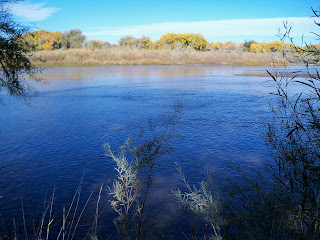
Rio Grande River


This is photos of the Rio Grande River as we saw it from the walk we took along the river. The first one shows the bridge we walked out on shown in the next post down or the previous post. The brush was really thick along the banks of the river so we could only get to the edge in a couple of places.


Gone to Texas...

Monday morning I left Columbia City. With daytime temperatures in the low teens for the 3 days I was there, I was looking forward to some warmer weather!

While I was home in October, my best friend from my college days (Indiana State University 1979-1982) found me on Facebook! (And through her I "friended" our Photography Professor and another classmate.) I hadn't seen Connie since 1985 (or thereabouts). I've driven through Terre Haute several times in the last 20 years and each time would think of her but never took the time to stop.

Monday afternoon I paid Connie a long-overdue visit. I took a chance that she would be home and not busy and stopped without calling ahead. Not good form, I know, but I didn't know I was going to stop until I got to the Third Street exit!

As luck would have it, she was home! We had a wonderful visit, though only about 90 minutes long. It was great to see her again and hopefully it won't be quite so long until the next visit!

Connie and Me. Photo taken by her daughter. December 13, ...
Connie's grandson, Declan, was doing his best to stuff his hand in my mouth!He is such a cutie! Blonde hair, blue eyes, chubby cheeks. And so sweet.
Snow was on the ground, but the Interstates in Indiana were mostly clear. They had just enough moisture on them so that trucks and cars sent up a fine salty mist. My black van is mostly white right now. Driving through Illinois on I-70 there were an awful lot of cars and semi-trucks in the median and along both sides of the highway. Many were “right side up” but several were on their sides and a couple had completely rolled over. Not a pleasant sight and I was thankful that I had missed the really bad weather.

Turning south on I-57 and I-55, the temperature started slowly rising, from 16 to a high of 24! Once into northern Arkansas the snow had disappeared and the roads were dry. Yesterday afternoon I smiled as the sun came out and the temp kept going up. It was a blustery 55 degrees when I stopped for the night a little ways west of Texarkana, and 55 degrees never felt so good before!

Saturday, September 7, 2013

To the Lighthouse

I have always been fascinated with lighthouses. Luckily, there are many in coastal New England. Even our wedding was next to a light house. Now for the first time, we have combined lighthouses and bicycles.

This is the red and white Nauset Light, operational since 1837. It is a short but very hilly coastal ride from where we are staying. From Nauset Light, a narrow bicycle trail through the woods leads to a truly unusual sight: the Three Sisters.

The Three Sisters stand in a semicircle in clearing in the woods: three small, pristine-white lighhouses. My camera is not wide angle enough to capture all three together - but here are two of them, with the Co-Habitant cycling in between.

The site is so quiet and unexpected; it has an almost mystical quality to it. Here I am next to the Middle Sister.

Miles and Marianne in front of the smallest sister. The Three Sisters are the only station in the U.S. designated by three lighthouse towers. Read more about their history here.

Friday, September 6, 2013

Gunks Routes: Te Dum (5.7)


(Photo: the opening moves on Te Dum)


It was still winter, technically, when I got my first Gunks opportunity of . But spring seemed to be in the air.The temperature had suddenly spiked up into the sixties. The internet hummed with reports of great early-season climbing.


I couldn't wait to get out there.


I was feeling pretty good. I was perhaps in better physical shape than ever before, and I'd been climbing well in the gym.


But it got colder as the the weekend began, and by the time my climbing day, Sunday,dawned, it felt like winter all over again. As I drove up to New Paltz with A and M, I watched as thethermometer on my dashboardreported the dropping temperature outside: 32, 31, 30...


It bottomed out at 28 degrees just before we hit Exit 18.


Whatever, I wasn't worried. The high was projected to be around 48 and I figured with the sun shining on the cliffs it would feel warm enough once we got into it. I suggested to my friends that we head to the Nears, where the classics are piled deep, one after another, at the northern end of the cliff, closest to the road. I was thinking of a couple good warm-ups for us. One was Alphonse, a 5.8 climb that'sreally a 5.6 for all but one move. Another was Te Dum, a 5.7 that I remembered as having only one 5.7 move on it:an exposed but easycrux step around a corner about two-thirds of the way to the top. I was eager to get started and I volunteered for the lead.


As we walked to the start of Te Dum we passed Broken Sling, a notorious 5.8 with a bouldery start and a poorly-protected thin traverse above. Like Pavlov's dog I started salivating at the thought of getting on that one. Then beneath our chosen climb I stared straight up at the crux downward-facing off-width that finishes the first pitch of Inverted Layback (5.9). Boy, I'd like to do that one soon, I thought. But first I have to knock off this easy 5.7.


We racked up and I headed skyward.


The climb starts just left of the back of an open book, at a wide vertical crack system that passes two ledges on the way to a third. At the third ledge, where the vertical crack system widens,you traverse to the right wall of the open book and head up past a few flakes to the crux move around a second corner. Once you make the thin move around the crux corner a few jugs usher you up to a small ledge where a tree used to have slings around it, forming an optional belay station. This tree has lost its largest branch and these days hardly seems suitable for belay duties; in any event the rest of the climb is 5.4 and short. A rising traverse takes you out from under the roof over your head and then it's a couple moves to the top. Best to do the whole thing in one pitch.


As I started the climb, worming up to the first little ledge, I realized Iwas actually feeling very rusty after our long, snowy winter. I wasn't used to real rock anymore, and neither my fingers nor my toes felt secure on the stone. Even though the sun was shining directly on the rock, it still felt cold to the touch, and it may have been irrational but I didn't feel confident that my grip on the holds was solid.


At the second little ledge, I found myself standing to the left of the vertical crack and couldn't figure out how tostep up. I had two pieces right there-- in fact, I'd placed four pieces of pro in about 10 feet-- but I confess I was starting to panic. I couldn't commit to the move. My fingers were feeling numb. I told myself this was just season-opening jitters and to go ahead and step up, but when (after what seemed an eternity)I finally did so I immediately slipped off the foothold and down to the ledge on the right side of the vertical crack, where I should have been standing in the first place. Now that I was standing two feet to the right of where I'd been standing amoment before, the move was obvious-- I'd fallen into the proper position. The rest of the climb went smoothly. The rock even started to warm up and by the time I got to the cruxI cruised through it, as I'd expected I would.


My verdict on Te Dum two years later: despite my jittery beginning, it's still, to my mind, an easy 5.7. The opening bit, up to where you move right, is a simple matter for anyone who isn't climbing (like me) with blinders on. Then a very easy and well-protected traverse (use the crack at the back of the open book for pro) leads to a couple nice moves up to the crux. One deep breath and a committing step will take you around the second corner to jugs and the optional belay. Then it's an exposed, 5.4 romp to the trees. A nice pitch, with more climbing on it than I remembered.


So much for starting the year feeling strong. I'd secretly hoped the Gunks 5.8s would feel ridiculously easy as the year began, but that's just not how it works, is it? You have to pay your dues year after year, make a few mistakes, get yourself a little scared, ask yourself why you're even contemplating this stupid sport. And then it all becomes fun again.


The rest of my day went much better. After myshaky performance on Te Dum I handed the lead over to A for Disneyland (5.6) and Alphonse (5.8), and these climbs did a lot to shake the slipperyfeeling off my fingers and toes. Then I took the lead for the first pitch of Yellow Ridge (5.7), which I'd never been on before, and felt absolutely fine about it. And then we hit Farewell to Arms (5.8), which A led and which I thought packed a ton of climbing intothe shortfirst pitch. This was not an easy 5.8, but I'll write more about that and our other climbs of the day in another post.


We ended our day with a rope up on To Be Or Not To Be (5.12), which none of the three of us could even begin to conquer. As we flailed away at it I couldn't take my eyes off of Birdland, just to the right, another 5.8 that has somehow eluded me these past couple years. I prefer roof climbs to face climbs, and Birdland is definitely in the face climb category, at least for its first pitch. But for some reason it just calls to me, and I'm going to jump on that sucker soon. Something about it just looks so appealing, and knocking it off my list early this year just seems like something I have to do. Assuming my jitters really are shaken off.

Wednesday, September 4, 2013

Phend-Fisher Family Reunion Ledger - 1916

1916 - Eighth Reunion

[page 1]
The Phend reunion was held June 24, 1916 at the home of Will Phend. there were 61 present to enjoy the bountiful dinner and the good times following. Victor Phend spent his last day with his relatives before departing for the Mexican border.

The total expense of reunion for the year 1916, was $10 all made up in collection. No balance.
Officers for the ensuing year are as follows
Pres. Will Phend
Sec'y Mrs. Mary Phend
Treas. Jacob Phend

Following election of officers was prayer by Jacob Phend
A short talk by Chirst Phend
Oldest present Jacob Phend age 89 June 27 1916
Youngest Mary Alice Phend age 14 mo.
Blanche Evelyn Heckman age 15 mo.

[page 2]
Marriages -
Cecil Phend
Ivy Phend
Waldo Phend
Ivy Senff

Births
Delta Conrad
Cecil Phend. daughter 4th of April

[those who attended]
Mr & Mrs John Phend
Mr & Mrs Henry Phend
Gladys Phend
Bernice Phend
Donal Phend
Vergil Phend
Paul Phend
Gerald Phend
Mr & Mrs Christ Phend, Mary
Mr & Mrs W A Phend
Mr & Mrs F. A. Wehrly } LaMarr & Evelyn
Mr & Mrs Herly Phend
Mr. & Mrs. Harry Phend and Mary Alice.
Mr & Mrs Ivo Phend
Mr. & Mrs Harvey D. Senff
Lucile Senff, Arlena Senff.
Mr. & Mrs. Ralph Albert

[page 3]
Mr. & Mrs. Archie W. Senff
Wilbur R. Senff
Lulu Conrad
Lucile Conrad
Harley Conrad
Mabel Heckaman
Jacob J Phend
Jacob Phend Sr
John W. Miller
Mrs J. W. Miller
Violet Miller
Mr & Mrs Jacob E. Senff
Ruth Senff
Lawrence Senff
Hilda Senff


The Phend-Fisher families gathered for a reunion in Elkhart County, Indiana almost annually from 1909 until 1943. Usually held at Nappanee, the events of the day were recorded in an old ledger book. Spelling has been retained as it was in the original though some punctuation and paragraph breaks have been added. To view all articles in this series click on the "Phend-Fisher Reunion Ledger" label at the bottom of this post.

Just Hangin'

We have finally hung the Motobecanes up on the wall and cleared up some floor-space in my art studio. Now there are "only" four bicycles there: the Pashleys and the vintage DL-1s. It is not a large studio by any means; I have no idea how we managed to store six bicycles there. At least now these two are suspended from hooks in the bedroom.

I think the Motobecanes look rather nice here. The door on the left is a closet, and yes the positioning of my mixte makes the closet impossible to open without taking the bike down. That is okay, because it is a long-term storage closet and we only open it occasionally. There was no other place to hang the bikes in the entire apartment; the rest of our wallspace is covered with book-cases.

We used common 5" threaded, ruberised hooks that you can easily find at any bike shop. They are intended for wood, and you need to be sure that you are screwing them into wooden beams and not drywall. Also, this probably goes without saying, but this method is not intended for extremely heavy bicycles, such as Dutch bikes or English Roadsters. Our vintage roadbikes are around 30lbs each, and I would not go much beyond that weight.

We like these hooks because they are sturdy, yet unobtrusive. We did not really feel drawn to bike trees and funky wall-mounting systems, as those tend to clash with the delicate ecosystem of our dwelling's aesthetic. With these minimalist hooks, the bikes remain the focus of attention, like fine pieces of art. Incredibly imposing art.