Friday, July 31, 2009

Reading and Riding

Rack Full o' Books
When I started cycling I never dreamed of getting into bicycle-themed literature. In fact, I intentionally avoided it. I guess I wanted to think of myself as "normal," didn't want to get obsessed, you know?.. Just a person who rides bikes, and nota person who is so defined by them that even her reading list is bike-themed.Fast forward several years, and my coffee table is littered with books and magazines about... you guessed it, cycling. My laptop has browser windows open to cycling-themed reading material. I'm a goner for sure. And you know what's worse? For some reason, most of the stuff I like is roadie themed. Let me explain: There is some truly excellent writing in this genre. Not just writing that seems good because I am into bikes. But writing that is so genuinely compelling in its own right, that it has gotten me interested in topics I had otherwise been indifferent to. Here is a sampling of my favourites, by category:


Book: The Rider by Tim Krabbé. I posted a sort-of review of it last winter and it remains my favourite. It is ultimately a novel about human introspection. That just happens to also be about bicycle racing. By the end, you may not be able to separate the two.


Writer: Limiting myself to just one, I would have to sayGraeme Fife. "I'm not greatly interested in results, frankly but the metaphysics and aesthetics of cycle racing excite me enormously," this man once said in an interview.


Magazine: I started readingRouleurbecause it was available at the Ride Studio Cafe libraryand I was looking for something to leaf through with my coffee. After a couple of issues I was hooked. The articles have an unexpectedly brooding, almost dark tone to them that lured me right in. I had no idea what I was reading about half the time, but it was gorgeous, so I kept reading until it gradully began to make more sense. That's how they got me.


Blog: Red Kite Prayer. This is a roadie blog that I really have no business reading. But the entries are so thoughtful and well written that I keep checking in and finding common threads, sometimes even patches of common ground.


Blog Entry: Favourite cycling blog post of all time is a masterpiece by a girl named Beth Newell. Now, this is a girl who went from riding her first roadbike to turning track national champion in just a few years, all the while documenting it hilariously. But my favourite post of hers has little to do with cycling, and focuses instead on a student exchange trip to Hungary. So, if you're having a dull night, do yourself a favour: Pour a nice glass of wine, click here, then search for the phrase "perhaps the most traumatic story about my calves dates back age twenty" and start reading from there. You will not regret it.

Thursday, July 30, 2009

Typically Dutch 010: Beschuit met Muisjes

The other week we received a surprise visitor at work, a female colleague who recently gave birth and her 10-week old son.

The Beschuit met Muisjes given to me. She gave birth to a son, so its white and blue muisjes. When its a girl, its white and pink muisjes.

In the Netherlands when there is a birth of a baby, it is customary for the new parents to treat visitors, friends, relatives, neighbours and colleagues with ‘beschuit met muisjes’. It is basically a thick flaky biscuit spread with butter and the muisjes on top. Muisjes are sugar-coated cumin (anise) candies. The butter holds the muisjes together so that is an important ingredient =)

Kids here eat the muisjes as a spread on the bread as well, with the butter of course, for breakfast and lunch.

The Dream? The Adventure!


I don't know what climbing, specifically alpine climbing, means to anyone including myself. I can no more tell you why climbing is so important and good for me than I can tell you how the universe was created or what "life" is.


But I know it started as a dream, a wish for adventure and a ability to comprehend what I saw in nature as something more than just special.

No matter what I climb, the type of terrain or how much I enjoy the moment it is all related to being in the mountains eventually and alpine climbing.

I get teased sometimes about my obvious boot fetish. Couple of things happened recently to bring me back to the original "dream", cold feet and why my desire of wanting to climb so badly.

The boot fetish is based on the reality of spending a lot of time out doors as a young kid. My parents hunted, fished and skied. Of course all that slowed down when they had kids..at least until we (the kids) could walk. And by walking I don't think we had to be able to walk far before we were off on their adventures. From my childhood I remember three things from those adventures, cold feet, how I liked heights when everyone else got scared and how much fun it was to be in the snow.

So the boot fetish should be easy to understand. I had cold feet from day one!

In the late 1950's the lookout shown above was the first place I remember seeing, and others talking about, climbing. I can remember my Dad walking with me out to the lookout and back hand in hand on that set of stairs. I was in the 2nd grade. Imagine my surprise to find out the Needles had its, "first recorded technical climbing is April 1970, Fred Beckey, Dan McHale, Mike Heath climbed the South Face of the Warlock, an 8 pitch climb rated 5.9." That ascent is of course a a full ten years after me seeing climbers in the Needles.

The view of the Needles from the lookout.


That was 50 years ago and I still get a thrill remembering the journey. It was another 10 years before I was to actually climb. But not because of a lack of desire. As I aged I remembered the thrill of that simple visit to the Lookout and the awe I had for the guys climbing on the rocks.

Learning to ski held my attention as did dirt bikes, basketball, football, bicycles, guns, knives and swimming. In the late '60s and early '70s our high school library carried a French magazine called "Paris Match" and even though I was taking French I couldn't read much of it. But, my Oh my, the pictures! Rene Desmaison made me WANT to be a alpine climber. Add a subscription to National Geographic my Grandmother gave at Chrismas every year since I was born (really, since I was born) and how could I not WANT to climb :)


" Readers of Paris Match read his dramatic reports and a radio audience measured in millions shivered with him during a live broadcast caught in a storm on the north face of the Grandes Jorasses......

In the 1960s when many of the so-called “last great problems” in the Alps were being addressed, Desmaison played a leading part in solving them. One attempt on the unclimbed Central Pillar of Freney, high on the Brenva face of Mont Blanc, became a France v Britain race. A team including Chris Bonington, Ian Clough and Don Whillans had a day's lead and were attempting the difficult overhanging crux of the climb when a group led by Desmaison appeared, attempting the same pillar by a nearby line. Bonington recalled that the corner crack they were trying to climb was too wide for their pitons but too small for the protective wooden wedges they were carrying. A request to the French for suitable gear met a firm and not unreasonable “non”, as the same gear was needed on their own route. Bonington and Whillans persevered, overcame the crux and dropped a rope to the rest of their team which the French then asked to use to ascend the difficult pitches. The rope was left, but seemingly failed to find a mention in French accounts of the climb.

Desmaison's closest brush with death came in the winter of 1971 attempting a new route on the Grandes Jorasses. With Serge Gousseault, a newly qualified Chamonix guide, the two climbers became trapped by violent storms sweeping the mountain face. After six days of slow, difficult climbing the weather had closed in. They reached a summit cornice, an overhanging lip of snow and ice, only a short distance from safety but were unable to move, hanging from pitons in a festoon of ropes. Rescue helicopters twice arrived above them but failed to understand Desmaison's signals for help. On the 12th day Gousseault froze to death and it was two days later that Desmaison, near death himself from cold and dehydration, was air- lifted to safety. Two years later he returned and completed the climb, once more arriving on the summit in a storm. "
René Desmaison, French mountaineer, guide, author and film-maker, was born on April 14, 1930. He died on September 28, 2007, aged 77

So between Desmaison and Gaston Rebuffat, another French Alpinist with a penchant for photography, writing and good climbs I was hooked long before I ever owned an ice axe.

Skiing, when I started, most still used leather boots. And the boots could be used for walking as required as well as skiing. Not cutting edge technology by any means even then but a whole lot of fun. Not a lot of difference between skiers and climbers then from my limited perspective.

Then while in high school our family moved to a little town just east of Mt. Adams. From our new home you could see Mt Hood, Mt Adams, St Helens, and of course Mt Rainier!

Now I just had to learn how to climb mountains! Of course I had no clue just how much mountains and climbing would come to influence the rest of my life.

A duplicate of my first "climbing" boots, age 14. Army surplus, alpine troop, ski and mtn boot. Bought in Lewiston Idaho with paper route money shortly before seeing Mt. Hood up close for the first time.

That was my start. Yours?


Wednesday, July 29, 2009

Philosophy Panniers: Two Versatile Classics

Just as I was lamenting the difficulty of finding classic commuter panniers that fit a variety of bikes and racks, a new company appeared offering just that: Philosophy Bags, based in Portland, OR. Handmade in the USA out of locally sourced materials, the description and looks of these bags were almost too good to believe, so I had to see for myself. Philosophy sent me their two pannier models to review: The Intrans satchel (above left), and two versions of the narrow Burnside (above right). We agreed that I would purchase the ones I wanted to keep, if any, and return the ones I did not.


Overview of the Models


The Philosophy Intrans is a traditional satchel design that will look familiar to all. I asked for the brown and tan model, but there are several other colour schemes to choose from as well. Its dimensions 14.5x12x6", the Intrans will fit a full sized laptop and more.


The proportions of the pannier itself are equally suitable for heavy-duty Dutch bikes and for more delicate roadbikes or mixtes. Although large, it does not give the impression of overwhelming a bike, as many other panniers do. And despite its size, heelstrike can be avoided on the majority of bike and rack combinations thanks to the adjustable hooks of the mounting system (details later in the review).


To my eye the Intrans looks most "at home" on a large, classic, upright bicycle - but this is a matter of personal taste.

Once opened, the satchel reveals a slight, expandable "roll top" - making it a bit more roomy than it appears to be when closed. The inner fabric is off-white. Inside is a suspended compartment with two medium pockets. A wooden ruler is attached to the base of the outer flap and acts as a support for the leather handle.


The Philosophy Burnside is a more unusual pannier. Narrower and longer than the Intrans, its outside dimensions are11.5x14x6". The narrower design makes it ideal for bicycles with short chainstays and small racks.


Though it does not look out of place on a heavy upright bicycle either. It is not a small pannier, just a differently oriented one. A clever design that is both roomy and avoidant of heelstrike.


Inside is the same suspended double-pocket as on the Intrans, only narrower.


The genius of the Burnside design is its expandability. While on the outside, it looks like a classic pannier, once opened it reveals itself to be a roll-top, offering considerably more room than one would have expected (the expandability feature is more dramatic than on the Intrans).


Here is the Burnside with the buckles open. Because the roll-top expands upwards, there is no possibility of heelstrike when the bag is opened; you can fill it will groceries and keep cycling.


This is what the Burnside looks like filled with 1.5 bags worth of groceries.


Features


Both the Intrans and the Burnside panniers have a number of distinct and appealing features. The US-made 23oz tri-ply cotton is water resistant, oil resistant, and breathable. The leather is vegetable tanned and likewise made in the USA. Buckles and D-rings are stainless steel.


Detachable messenger straps are included with both bags, as are leather teathers for the optional attachment of rear reflectors. The reflector can be moved from one D-ring to another, depending on what side of the bike you attach the pannier to.


The buckles feature snap-closure attachment, making the bags fast and easy to open and close on the go.


The snaps are heavy duty and secure.


The satchel-like Intrans pannier comes standard with a leather handle, and such a handle can also be added to the Burnside as an optional extra feature.


Mounting System


Philosophy panniers feature the Rixen & Kaul Klickfix mounting system - a well-tested system that is also used by Berthoud and Carradice. Having tried several other pannier mounting systems previously, this is my favourite one so far. It took me a few minutes to understand how to operate the hooks so that they close around the rack tubing, but once I got it they were simple and quick to use.


The R&K system isadaptable to racks with a variety of tubing diameters (8-16mm), making it extremely versatile. The hooks are not only large enough for racks with thick tubing, such as my Gazelle, but they are also sprung - which allows them to close just as tightly around racks with thinner tubing, eliminating bouncing.


The hooks are attached to a long aluminum rail, along which they can be slid to a position that avoids heel strike even on bikes with shorter chainstays.


The lower hook is supplementary, and helps keep the bottom of the bag from bouncing or flapping. The plastic side-hook slides along the rail and clips to the racks stays.


I have tried the R&K Klickfix system on four bicycle racks so far: The Velo Orange Constucteur Rack with thin tubing, the handmade Bella Ciao rack with medium tubing, the Gazelle rack with thick tubing, and the Pashley Roadster rack with monstrous (even thicker than the Gazelle) tubing. On the Pashley Roadster rack,the R&K hooks are a tight fit, possibly too tight for recommended use.On all the other racks, themounting system fits without issues. Regarding the PashleyRoadster rack, note that the largeOrtlieb QL-2 hooks fit equally tightly, and note also that the Pashley Princess does not use the same rack as the Roadster and the R&K system should fit it easily. It's possible that the tubing of this particular bike's rack is simply too thick for any pannier.


Criticisms


It took me several weeks to take all the pictures used in this review and to test both panniers, and during all this time I have been trying to come up with something critical, but not having much success. As far as functionality goes, I can't really think of anything substantial. One point to note, is that when I wore the Burnside over my chest "messenger style" off the bike, the lower (supplementary) sliding hook got caught on some of my clothing - namely the hems of cardigans. This only happens when the bag is in some positions, not others, and it does not happen when the bag is worn over one shoulder.I'd prefer it if the Burnside had a leather handle and I could simply carry it in my hand - and as mentioned earlier, Philosophy informs me that this is now an option. My only other suggestion would be to possibly reconsider the colour of the interior and the shoulder strap: The off-white is attractive, but a darker colour would hide stains and age better. Other than that, I honestly cannot think of anything. These panniers are exactly what I wanted in the sense that they are classic, roomy, and can fit all of my bikes without heel strike or rack compatibility issues.


Which to Keep?


The Co-Habitant will be returning the black Burnside, because he does not feel comfortable with the hooks' tight fit over hisPashley's rack.And as much as I love both the Intrans and the Burnside, I will keep just one pannier, as I neither need nor can afford both of them. It's a tough call. The Intrans is a more traditional satchel design and feels somewhat better balanced in my hands. The Burnside fits all of my bikes in such a way that the hooks don't need to be adjusted from one bike to another, which makes it more convenient for multiple-bike use. I think that this feature may end up winning, and I will keep the Burnside while tearfully returning the Intrans. Or maybe not! Either way, Philosophy panniers are high quality, well though-out, versatile and classic products that are well worth their price and are unlikely to disappoint. Best of luck to this new company.

Lions, Lambs, and White Flowers

Between cool snaps and dark windy days, there are a few warm, sunny, glorious hours. Spring is sneaking in.

We've seen a few swallows, a bat, and lots of mosquitoes and gnats. (I've had two itchy bites already.)

It's not really planting time yet though. At the gardening conference, I tried tying my hands behind my back to keep me from buying any plants so early.

But they had Sun Golds. Last year after reading a book about a New York couple's adventures in market gardening, I looked everywhere for Sun Golds, the cherry tomato that they had praised to the heavens. No joy. I could find the seeds, but they need to be started indoors and there's just no room.

So when a vendor at the conference had Sun Golds, I had to get them. And then I figured I might as well get a few other things as well.

While the tomatoes are in an aggravating "outside during the day - make sure they're out of doggie reach - remember to bring them in at night" arrangement, the lettuce and broccoli could go in the ground right away.

Which of course was a powerful signal to mother nature, to unleash a hail storm and days upon days of rain.

I took these pictures last weekend, before all the bad weather came to town. If sound were an option, in the background you'd hear a husband and a dog begging me to hurry up and quit taking so long.


Bloodroot. One of my favorite spring wildflowers. Even the latin name has blood in it: Sanguinaria canadensis. It looks dainty, but it must be tough if it has the name "Canada" in it and can live in Alabama too.


Rue Anemone (Thalictrum thalictroides or Anemonella thalictroides). A magnified bloom. In real life it's less than an inch (2.5 cm) across.


Toothwort. The genus used to be called dentaria, alluding to the roots that look like teeth, but was changed to cardamine. (If you know why, clue me in.) There are lots of species of toothwort. I think this one is Cardamine concatenata. I've read that you can eat the peppery roots, but I haven't tried it.


Toothwort close up.

Monday, July 27, 2009

Foggy Day in the Garden


Heavenly Blue, originally uploaded by ParsecTraveller.

It's foggy outside right now, but that hasn't stopped the morning glories from opening.

The fog probably has, though, stopped the tomatoes from ripening...

Thursday, July 23, 2009

Springy


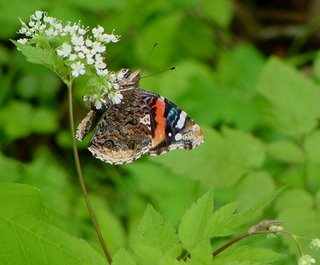
Red admiral butterfly on Sweet cicely. (Vanessa atalanta on Osmorhiza longistylis.)

This is the same type of butterfly from last year's butterfly wrangling post.

I know that they are widespread, but somehow it still surprised me to see a picture of one on a blog from Israel that I ran across recently. (Lots of nice flower and cat pics there too.)

-----

Technical note: Yesterday's bluebird post was MIA for most of the day due to Blogger problems, sorry!

It will probably be Rurality Lite for a while due to several things (none of which are bad news). Some obnoxious bragging coming up soon about one of them.