Tuesday, October 20, 2015

Green green green


Much better than last year's drought, but my nose won't stop itching.

Monday, October 19, 2015

It's Over...

This weekend has been fantastic! I've had the bestest time ever meeting genea-bloggers as well as other genealogists and even attending a few sessions! It's been such a great time, I really didn't want it to end. I think many of us felt that way.

Thank you to the Geneabloggers Swag Bag Team of Amy Coffin, Thomas MacEntee, Joan Miller, and Denise Levenik for putting together a wonderful assortment of items for us. Another thank you goes to the Sponsors for providing that swag!

I'll post additional photos and more information in the very near future. Thanks to everyone for an absolutely amazing time!!!!


in front: Miriam Midkiff (AnceStories), fM (footnoteMaven and Shades of the Departed), Becky Wiseman
the others: Kathryn Doyle (California Ancestors.org), Cheryl Palmer (Heritage Happens), Denise Levenik (The Family Curator), Elyse Doerflinger (Elyse's Genealogy Blog).

Thomas MacEntee (Destination Austin Family and Geneabloggers), Joan Miller (Luxegen Genealogy), Becky Wiseman, Randy Seaver (Genea-Musings), Miriam Midkiff (AnceStories), Craig Manson (GeneaBlogie), and Susan Kitchens (Family Oral History).

Saturday, October 17, 2015

Delving into the Deeds

In addition to the Yarians, Ruperts, and Switzers I have Berlin, Coy and Hoffman ancestors who lived in Columbiana County, Ohio. All of them in the 1803-1860 time period and all in the northeastern tier of townships: Unity, Fairfield, and Salem, and Green (which would become part of Mahoning County when it was formed in 1846).


By the beginning of my second week in Salt Lake City, I had pretty much gotten through my original, rather short, “to do” list except for one item that I knew would consume a huge amount of time. It simply said “Land Records – Columbiana County.” I've had good luck before with land records naming heirs of an ancestor and was hoping for some more luck, especially in the Rupert and Switzer lines.


If you have never done any work with deed records, be forewarned that it can be tedious and confusing. But it can also be extremely rewarding. First you have to search for the desired name in the General Index to Deeds. There are generally separate books for those purchasing land (grantee) and those selling land (grantor). The index will provide the name of the grantor and grantee, the date the transaction was recorded (could be just the year, and the recorded date could be many years after the date of the transaction), the location of the land (in the case of Ohio it is by Range, Township, and Section), the type of deed, and the volume and page number of the deed book in which the transaction is recorded.


This nice tutorial Taking The Mystery Out of Land Records is helpful as a reminder or as an introduction to working with deeds as is this list of Terms used by the Register of Deeds. (There are many others “out there” on the internet, these are two that I've used in the past.)


There were four rolls of microfilm with the grantee index and five rolls with the grantor index covering the years 1798-1897. It would take nearly two full days, but I transcribed each entry in the index books for my known or presumed ancestors John D. Berlin, Henry Coy, Detrick Hoffman, John Hoffman, John Rupert, Jacob Switzer, and Conrad Yarian along with a few entries for others with the surname Rupert and Switzer..


The first day I made it through the grantee index, writing them out by hand. Then, that night back at the campground I typed each entry into a spreadsheet. Duh! Duplicate work. The next day I arranged the netbook so I could type directly into the spreadsheet. A little awkward, but it worked quite well.


After getting the entries from the grantor index entered I sorted the spreadsheet several different ways to review the data. One was attempting to match up the sale of a piece of land to its corresponding purchase, another sort was by township, and yet another by surname.


All of that was done so that I could determine which deeds should actually be looked at. There were too many of them to review them all. Top priority was given to those that were sold by “so and so, etal” (etal means “and others” which could indicate a sale by heirs of the owner of the land) and to those that were sold with a “Quit Claim” deed (sometimes indicating a sale to another family member). I then went to the Library Catalog to get the film numbers and added that information to the spreadsheet.


A small portion of my list of deeds.

I actually looked at about 1/3 of the entries on my list. I had highlighted the records that I really wanted to look at and had sorted the list by film number so I could see what else was on the same roll of microfilm. Even then, I didn't always look at everything from my list on the same roll of film – sometimes I got distracted by what I found in certain deeds and went off on another tangent looking for something else! That's the beauty of being at The Library where a wide variety of sources are available.


As I looked at the deed records I abstracted information from those that were “of interest” to me, adding that information to the spreadsheet. Some documents were scanned while others were just abstracted. There simply wasn't enough time (or even a need) to scan them all.


The spreadsheet with data added after reviewing the deed.

Was it worth the time it took to make that extensive list of land transactions? Yes, indeed! (Pun intended.) It was definitely worth it. What I found in those deed books was cause for more than one Happy Dance and in future posts, I'll summarize a few of the things I found and the discoveries which followed.


Wednesday, October 14, 2015

Glacier Peak

After years of trying, we finally made it up to climb Glacier Peak. At 10,541', it is the fifth highest peak in Washington. It is located northeast of Seattle, way out in the middle of nowhere. Luckily, all aspects of the 15 mile approach are beautiful. It is hard to keep your eyes on the trail. The forest features huge Douglas fir and cedar trees.
The trail goes through about 7 miles of forest and then climbs up to join the Pacific Crest Trail. The hillsides are covered in Heather and numerous wildflowers. We must have crossed 20 small streams on the way.
After almost 10 miles of hiking, we get our first look at the mountain. At this point we are still several hours from our high camp.
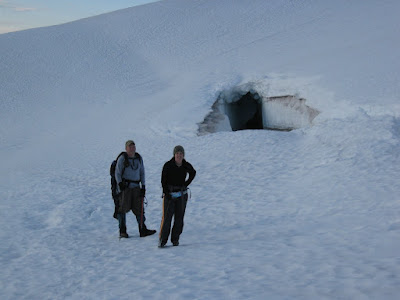
The clouds started to roll in during the night. We had to get going earlier than we had planned to try to summit while we had a chance. Our route took us over parts of the Gerdine and Cool Glaciers. This large crevasse was near Disappointment Peak.
Climbers nearing the top.
Emily, Doug and Dave on the summit. The Glacier Peak Wilderness is full of inviting snow covered peaks.
We broke camp and started the long hike back to the car. As we headed out, clouds began to cover the mountain. Pretty soon we could hear distant thunder.
We saw a few marmots along the way.
Tiger Lilies beside the trail.
We made it back to the car before dark. The downpour began soon after that.
With the low elevation trailhead, the long approach and a lot of ups and downs, this climb was as taxing as climbing Mt. Rainier. It was nice to finally stand on top of the mountain that we have seen so many times from other summits.

Monday, October 12, 2015

Jordan Diaries: Arriving in Amman and the embassy suburb

Now back in the Netherlands, and with all my fotos uploaded to my laptop, I can now begin my Jordan travel diaries. You might have noticed [grin] that I love chronicling my travels and this is mainly because the act of writing what I have experienced is akin to re-experiencing the experience. Like déjà vu. Besides, it somehow seals the whole experience for years to come, for me to come back to and live through them again. This is hoping that Google, the owner of Blogger and Youtube, and Multiply (this did and I have to re-upload the pictures to my Google storage) as well will not go into administration and I can turn back the clock and look at my blog entries and fotos with a smile and a hint of familiarity—oh yeah, I have done that, I was there.


Arrival at Queen Alia Airport + Pre-entry Visa


So I will start with our arrival in Amman. We landed just before 18:00 in Queen Alia International Airport. Dutch nationals are not required to have a pre-entry visa but Jordanian immigration authorities requires a visa for most foreign nationals entering which can be bought without hassles at the port of entry. We went straight to the visa section to buy our visas which is 10 JOD (1 JOD is 0.95 EUR). There is a money exchange kiosk and I believe an ATM just before the visa booth, so that is handy if you do not have Jordanian Dinars because they do not accept any other currency nor credit card payments.


Stunning tail, the crown logo makes everything for that grandeur royal look.


Plane views just before landing.


I am quite loyal to KLM but there are instances when I have to fly a different airline out of convenience. KLM does not have a direct flight from Amsterdam to Amman. Royal Jordanian airline is the only airline that flies direct. Their planes look very pretty from the outside although I can tell they are a bit old already. Food was nothing to rave about. I must say that service was SUPERB. Lovely RJ cabin personnel.


Very colourful Jordanian Dinars.


Taxi drive to Amman


18:15 and we are in the taxi to the direction of Amman. The drive to the capital is going to be about half an hour. Cabbie driving skills was OK, nothing near a rollercoaster ride.


The taxi drive from Queen Alia International Airport to Amman Centre -- about half an hour, costs 19 JOD.


Passing through Abdoun Bridge.


Our hotel in the embassy suburb of Amman


We arrived at our hotel—Hisham Hotel, a local Arabic owned hotel located at the back of the French Embassy in the 3rd circle. We arrived just before sunset so we had a good look at the surroundings.


Military security personnel in the posh neighbourhood of our hotel.


The area is somewhat an upscale hub of Amman where a lot of embassies and high-profile people are living. Security in military fatigue authoritarian uniforms with high powered rifles guarding entrances of many buildings and properties proliferate the neighbourhood. They are in every corner. We even saw a military jeep with a high-powered machine gun launched on top of the vehicle ready for action. For a moment there Blondine and I felt we are in the smack of war zone Middle East! lol


However, I think our location is the safest part of Amman, what with all these severe security patrolling and guarding the area.


Here is our hotel room:


Our hotel room was quite big, with wide floor to ceiling mirrors (we love this of course), with free internet, and it even has a Louis Vuitton trash can in the toilet, haha. Beside Hisham Hotel is the oldest bar, they say, in Amman. We checked it out quickly (forgot to take a foto) before retiring to bed early.


The view from our balcony: Amman.


A little stroll along Al Rainbow Street


Anyway, after checking in to our hotel, we asked the hotel manager if he has recommendations for a great restaurant. We want the best traditional Jordanian restaurant in town for dinner that night. He called up his first choice (forgot the name of the restaurant) but it was fully booked. Argh, happens all the time with the best restaurant huh. He gave us another alternative but we decided to just do our own thing and went to Al Rainbow Street in the 1st circle instead to see what night life in Jordan, a Muslim country, is like.


The taxi (rate is 1.5 JOD to 2 JOD max within Amman, do not pay more!) brought us to Al Rainbow Street in 5 minutes and we walked the whole stretch filled with commercial shops, Arabic fast foods and café restaurants offering non-alcoholic drinks and the famous hubbly bubbly—Shisha or Hookah or in plain English, waterpipe. Some restaurants do offer beer so for those who cannot disentangle night life and alcohol there is light at the end of the tunnel here.


Wandering along Al Rainbow Street we came across this Arabic fast food place making Falafels(fried chickpea balls). They are good but not really my favourite.


I guess this is the best place to go in the evening if one has to experience the local Amman, Jordan night life otherwise popular venues with similar or much better offerings would be the modern international hotels but it won’t be quite near to going local.


We had dinner in Old Times Restaurant and then people watched for the rest of the evening really. When we had our fill of the Tahini Kufta and had coffee, we took a cab back to the hotel and pretty much tucked ourselves in early to get ready for our next adventure day in Amman.


More of our Amman diaries next...


Thursday, October 8, 2015

Saddlebag as Buffer Zone

With most of our bicycles fitted with saddlebags, we've noticed a welcome secondary benefit: They provide an effective buffer zone. Should a bicycle fall or come into contact with an abrasive surface, the bag can protect the frame, components and saddle from getting damaged.

When a bicycle is on its side, it essentially rests on the saddlebag, without the saddle itself touching the ground. If the bag is large enough, it can even provide enough of a buffer so that the drivetrain does not suffer from impact.

The saddlebag is also helpful when you need to rest the bicycle against a rock or a fence. Even if you have a kickstand, sometimes it is too windy to use it, or the ground is not stable enough, and you are better off resting the bike in a position where it can't fall. On the picture above you can see that the saddlebag allows for almost the entire bike to avoid contact with sand or rock. While the primary purpose of a saddlebag is, of course, to carry stuff, the "buffer zone" it provides is tremendously useful. I have scuffed the saddles on every bicycle I've used without one.

Monday, October 5, 2015