 On one of the most frigid nights before , we went on a late-evening errand to the art store. Not wanting to have yet another "I am too cold to enjoy cycling" experience, I resorted to my floor-length down parka.
 It may seem improbable that one can cycle in a coat like this, but it is doable. What you need is the kind of parka that unzips both from the top and from the bottom. I simply unzip it from the bottom to create whatever size opening I need for pedaling.
 Bike and parka in motion. The shot is blurry but it shows off my headlight beams. The dynamo-powered headlight points forward (the beam furthest ahead of the bike), while the LED headlight points down at the road. This is essential when there are trecherous patches of black ice on the road, like now.
 The art store is about a 20 minute walk from my house, or 5-7 minutes by bike. This is fairly representative of what my winter rides are like. Most of my current daily destinations are only 1-2 miles from my house, which makes for very short bike rides. For longer destinations, I used to rely on the Charles River Trail, which is not accessible once there is ice or snow on the ground - so in the winter I have not been going to those further-away places nearly as much.
 Goods from the art store. The small bag looks deceptively modest, but the content - paintbrushes - can be painfully expensive. The store was having a sale and this was the last day of it, so I am glad I remembered on time.
 Happy with my new paintbrushes.
 After the art store, we decided to experiment with what it would be like to take a longer ride in freezing temperatures, and rode for a bit on a major road that leads out of town, stopping at a coffee shop and then heading home. It was okay, but did not feel entirely safe. The right lane was like an obstacle course: clusters of hardened snow suddenly popping up, potholes, icy patches. In addition to the parked cars on the right and moving cars on the left, it was a bit overwhelming to constantly watch out for all this, especially after dark. The good news is that with the parka I was at least able to finally cycle in these temperatures without feeling uncomfortable. A parka may look silly on a bike, but so what!

 Of course with all this talk of drought the weather decided that this day was a good day for a drizzle of desert rain while we were sight seeing through some of the shops. The rain only lasted about 10 minutes. Long enough for Sarah to get wet and chilled while she run back to her van to roll up the windows she had left cracked open for the dogs. (Yes, we had her dogs with us since we had started the morning by going to the river and had returned to her house yet. They are used to being in the van lots as she takes them with her as long as it is not middle of the summer weather.) But there was a nice rainbow afterward over the Mesilla plaza. Being November the trees around the square where still in their fall colors and they flashed color brighter colors to us after being washed by the rain. Old Mesilla (pronounced Ma - see - a, the double ll's on most Spanish words are silent.) was a stopping place for travelers going from Texas to California. Many of the building were built in the early to late 1800's. Mesilla was a stage stop for the Butterfield Stagecoach Company. It is said there was a population of .. in Mesilla in about 1860. Mesilla became part of Las Cruces as the two towns grew into one. Las Cruces being named for the Three Crosses that were put over the graves of three travelers or priests that died when they were attached by Indians. Now there is some non-religious person saying that the name of the town needs to be changed because the name Las Cruces or The Crosses has to much religious meaning. I am not a religious person, but the name has been there for so long it should always be there and as far as I can tell it really doesn't have any religious meaning to it. Most graves have a cross over them. That doesn't mean the person buried there was religious. I can not believe that so many people are going against our historical names here in New Mexico and other parts of the southwest and Yes, all over the United States and trying to change any little part that seems religious to them. Again I am not religious but I still say 'under God' when I say the Pledge of Allegiance because that is what I was taught in school, although research has shown that the first Pledge didn't have those words in it.

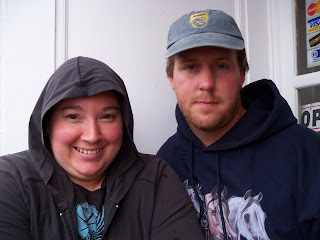 Desirae and Dustin in the rain.


 Many of the shops and business in Old Mesilla are adobe building that have been remodeled to bring them up to code but still have the old look.

 I have written about Anna's Retrovelo Paula before, but I was not able to evaluate the ride after what was only a couple of minutes on a cold November day. This time around it was summer, and Anna and I went on a nice long trip along the Danube - she on her Retrovelo Paula and me on theSteyr Waffenrad (the bike I ride while in Vienna). Our ride was30-miles round trip, and for a stretch of it we swapped bikes.
 Here is Anna on her beautiful bike.
 I must pause and mention here that she was wearing a stunning outfit taylor-made for her in India: slate blue kaftan, white trousers and white cape. It looked elegant and kept her cool on what turned out to be a very hot day.
 But back to the bikes: neither the Retrovelo nor the vintage bike I was riding had a problem with the magnitude of the ride, which did include occasional (but mild) hills.
 We rolled out of Vienna and passed through the beautiful countryside of Klosterneuburg, Krietzendorf, eventually stopping at a scenic spot in Greifenstein.
 Here is me with the Retrovelo Paula during our trip. This dog decided to join us for a bit - no doubt because he liked the bike!
 Anna's feet and sandals. My main impression of the Retrovelo Paula is that it is a comfortable ride with a feel of gliding to it. The bicycle is clearly well-made and of high quality. It rode very differently from the vintage Austrian bike I was on, but similarly to my Pashley back home (afterthe latest round of modifications I made to the Pashley). Prior to its latest modifications,I would say my Pashley was more sluggish than the Retrovelo Paula, but post-modifications they are about the same. One interesting point, is that I did not feel a huge difference in "cushiness" between the Delta Cruiser tires that I had been riding on my vintage bike, and the Fat Frank tires on the Retrovelo; to my surprise the ride quality was similar.
 Overall I liked the Retrovelo Paula, and found its ride quality to be in the same general category as that of Pashley and Velorbis. I think that between the three of these, preferences really depend on individual tastes more than anything else. I know of one former Pashley owner who tried the Retrovelo, liked it better, and has now gotten one (and is selling her Pashley). However, I do not feel the same, and wonder how much of the difference she felt is component and setup-related. The Retrovelo is a very pared-down bike in comparison to the Pashley, and I think the choices of tires and gearing further contribute to the sportier feel of the ride if we compare their "out of the box" set-ups - but all of that can be changed, and I feel that the basic ride quality is similar.
 In terms of manufacturing quality, I would rateRetrovelo as being on par with Pashley and better than Velorbis.Aesthetically, I think the Retrovelo has hands-down the best fork-crown design and lugwork of the three, but it has a few practical drawbacks - such as a lack of chaincase and dressguard.As for weight, the Retrovelo Anna was riding felt to me as if it weighed exactly the same as my Pashley at home; it is not a light bicycle by any means.
 The bottom line is: the Retrovelo is an excellent modern bicycle built in the classic tradition. It is fairly fast and maneuverable, comfortable, gorgeous, and its owners love it. If it is within your budget, I doubt that you will regret choosing this bike.
 But... I have yet to find a modern bike with a ride quality I like better than my vintage Raleigh DL-1 or the vintage Steyr Waffenrad I ride in Austria. I honestly wish that wasn't so, as I'd feel more comfortable riding a reliable modern bicycle than a vintage one. But it is as if the modern designs did something to the geometry of the bikes that has made them less efficient than their vintage equivalents. Maybe someday I will figure it out.
 In the time honoured tradition of celebrating aging, today I shall pry myself away from the internet, thus sparing you from the usual tediously long post. My cat advised me to follow this course of action, and when she has something to say it is usually wise to listen.
 But lest you feel that your visit was for naught, I would like to share a recipe for a splendid non-alcoholic cocktail - in response to popular demand after an earlier post. This here cocktail is as refreshing as it is safe for work, and I myself shall be enjoying it throughout the day with abandon:


 Dani glissading.
 Wipeout!


