Wednesday, December 10, 2008

RAIN! RAIN! Finally

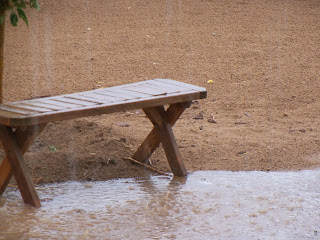
On July 20th we had the first major rain we had had in about a year. My rain gage showed just under an inch. We have been needing rain despertly and finally we got some. The whole state of NM has been in a drought for several years that had got really bad this summer. But in July what is called the monsoon rains started slowly inching their way into the state. Each afternoon we would hear of some little bit of rain somewhere. Many times we watched the clouds come in and could see some rain falling in and around the Albuquerque, Bernallio, Corrales areas, and even in down town Rio Rancho but not exactly where we are. This is when we have big, beautiful white thunderhead clouds come rolling in with a lot of them over the Sandia Mountains. The ones in these photos arn't as good as some of them but they were the ones that brought us the rain this day. We didn't really expect to get anything but a few drops as is normal when it first started and then it turned loose and became a gully-washer. A male rain as the Indians call it.If you had been in an arroyo or ditch it would have been a nasty flash flood. It is amazing how much water can come down to only be listed as less than an inch on the rain gage. The photos showing big puddles of water were quickly soaked into our thirsty ground.
The next day we got some rain again but it was only a light rain, the kind we really need so it can soak in instead of running off. A female rain.
But no where in the state have we had enough to get us back up to a decent leval of water in the rivers, creeks, and underground water table. It has been good for helping with the fires but not enough to put out that big fire that is still burning west of Los Alamos.
We are hoping for more.


Monday, December 8, 2008

Re-Trying the Moustache Handlebar

A Homer Hillsen

Iconic of the Bridgestone XO era and later championed by Rivendell, the Moustache handlebar is perhaps more popular today than ever. The dramatic forward sweep, the sideways-mounted road levers and the bar-end shifters make for avisually distinct and intriguing presence. The design is easiest to understand if you think of it as a flattened out drop bar, with the brake levers installed on what would have been the hooks. Grant Petersen designed the Moustache in the early 1990s specifically for the Bridgestone XO bicycles, as a kind of a hybrid between upright and drop bars. Today several manufacturers produce their own versions (including Soma and Origin8), though likely the Nitto/ Rivendell model remains closest to the original.


A Homer Hillsen

I first tried Moustache handlebars three years ago, and I remember being surprised by the leaned-forward position they put me in. Unlike the handlebars you see on city bikes, the Moustache is swept forward, rather than swept back - putting the rider's hands way out there, forward of the stem. Depending on stem length and handlebar height, this can be quite an aggressive lean. Recently I tried the bars again: I've been getting questions about them from readers and wanted to refresh my memory.


Riding with Moustache bars again was fun; my riding style has changed so much since the last time. These bars are unique and remind me of no other handlebars I've ever tried, so it's hard to find a point of reference. The forward sweep is vaguely North-Roadish, with two notable exception: All the hand positions are forward of the stem, and the brake levers are in the forwardmost points of the sweep, rather than in what we are accustomed to thinking of as the gripping areas.


A Homer Hillsen

The shape of the handlebars feels pretty good, and I have no trouble squeezing the levers from their location (here is anillustrated guideto the hand positions). However, I find the setup counterintuitive. Squeezing the brake levers puts me in a forward-leaning position, whereas using the bar-end shifters puts me in a leaned-back position: the exact opposite of what I am used to. After all, when I squeeze the brake levers I am trying to reduce speed - and the aggressive posture counteracts that - especially when coming to a complete stop. It was interesting to experience the discrepancy between what my body wanted to do when stopping and what the bars wanted me to do. On my own bikes, I prefer for the brake levers to be in a location that allows my posture to be more relaxed.


A Homer Hillsen

A friend who rides with Moustache bars explains them as a variant of riding with vintage, non-aero drop bars (where you brake mainly from the hooks). He believes those who are used to that will find braking with the Moustache intuitive, whereas the likes of me who mostly brake from the hoods of modern drop bars - or from the edgemost gripping areas of swept-back handlebars - may have trouble with the setup. He could be right. Either way, it's a handsome handlebar that I enjoy seeing on others' bikes.

Saturday, December 6, 2008

Mono Lake

Mono Lake near the town of Lee Vining in east-central California.October 11, ..

Thursday, December 4, 2008

Velo Transgressions

I saw this bicycle yesterday, chained to the railing of a restaurant in Harvard Square directly under a series of neon "No Bikes Please" signs.

The restaurant responded by taping this note to the saddle:
"This, actually, is a bike, of which yon sign speaks.
(Please don't park here this weekend)".
Plenty of businesses would have (gleefully) had the lock cut and disposed of the bicycle, but this restaurant was nice enough not to. I wonder what was going through the bike owner's mind when locking their green-tired pride and joy directly under a "No Bikes" sign. It seems like the kind of intentionally transgressive act that gives cyclists in Boston a bad reputation.

This made me think of an incident a couple of weeks ago, when I wanted to go into a place of business, but the bike racks outside were full. I peeked inside with my bike and asked whether I could leave it in the lobby since there was nowhere to park it outdoors. The person I addressed was immediately filled with rage, and said something to the effect of "Don't even think of coming in here with that! You people think you can do anything you want with those bikes!" In the area where I live, I have noticed that bikes are often associated with transgressive behaviour. Some cyclists encourage this; then other cyclists reap the consequences.

Scottish Sport Climbs guide is here


Finally, we have the first stock of the new Scottish Sport Climbs guidebook by the SMC. It’s in the shop here. It has certainly been a long time coming. I first submitted a draft of the sections I wrote in November 2004! A lot of bolts have appeared across the lowlands, highlands and islands since then, so the book is a lot fatter than it would’ve been if it had been released at that time. So the wait has an upside.


Flicking through the guide as I took it out of the box, I was struck by the great selection of sport crags all over the country now. There are 1300 routes in the guide, on 100 crags. Who out of the slightly older generation of Scottish climbers would’ve thought we would have 1300 sport climbs in Scotland. That’s great! As you’d expect from an SMC guidebook it’s a nicely produced book with careful descriptions, good maps and plenty of nice pictures to inspire. So many of Scotland’s new routing activists have been very energetic over the past decade and the options now available for routes to enjoy has basically exploded. Now, there are sport crags for us to visit no matter what corner of Scotland you find yourself in or fancy travelling to. Also, the diversity of locations mean that I can’t see many days of the year where there won’t be some dry rock on which to clip bolts somewhere in the land.


Kudos to all who made the effort to open new sport routes, as well as all the authors and producers of the guide. It is so badly needed. Talking to the new generation of young sport climbers coming into climbing through Scotland’s climbing walls, it frequently nagged at me that so many are unaware of the lovely crags that are out there. Some of them in stunning, wild and far flung locations like Gruinard in the north west. Some of them just up the road from our major towns and cities.


The guidebook pictures brought back some nice memories for me of places like Dunglas just outside Glasgow, where I did my first 6b (Negotiations With Isaac)and 6c+ (The Beef Monster). I remember being very excited when Andy Gallagher asked me to give him a belay on the first ascent of Persistence of Vision (7a+) after watching him bolt it. A year after my first 6c+, my first 7c+ (Dum Dum Boys) was a liberating experience and straight away I wanted to get to the ‘happening crags’ of the day.


I found myself at Steall for the first time shortly afterwards, abseiling down Cubby’s project (Ring of Steall 8c+) and being totally inspired by how poor the holds were. The whole ambience of hard physical climbing in beautiful highland surroundings was where it was at for me. So in the following years, we made after school/uni/work hits from Glasgow to Glen Ogle, Dunkeld and Loch Lomondside sport crags, with weekend trips to Tunnel Wall, Steall, Weem and the Angus Quarries.


Once I got involved in exploring new routes, under the influence of Dave Redpath and Michael Tweedley, I immensely enjoyed tearing about bendy roads in Argyll developing crags like Tighnabruaich and eventually the Anvil.


One thing that I like about Scottish sport climbing particularly is that the easier graded routes in the 6s and 7s are often so much better to climb than those on the continent. In Spain or suchlike, the majority of the time, the hard routes on big overhanging sweeps of limestone are the most inspiring lines, while the easier lines can sometimes be either a bit scrappy or, dare I say it, a little boring. As with our trad, the variety of rock types we have in Scotland often make for much nicer routes in the lower and mid grades too. However, if you are into hard stuff, the two hardest routes in the book (Hunger, 9a and Fight The Feeling, 9a) give as good climbing as you’ll get anywhere. Both were climbed in good conditions in the summer and you wont find any queues or some barky dog wondering about eating your lunch at the base of the crag. The only negative on offer from Scottish sport climbing is, of course, the midge. Just remember that the wind direction is as important as the rain when you look at the forecast. Choose a crag exposed to a breeze on the day, and you’re sorted.


Enjoy the guide, enjoy the climbing. It’s here.

Saturday, November 29, 2008

The Destination :: GeneaMecca

Friday, May 20th – I know, I'm just a little behind on posting, but there is a good reason. I've been spending some time preparing for the “ultimate destination” for any genealogist! Yes, that's right – I'm in Salt Lake City!! And spending some time with my friend Carol Stevens from Reflections From the Fence.


Here we are with our “stuff” heading out to the library this morning. Photo taken by Carol's husband “Man”.


You'll have to excuse the black and white, I was so excited that I didn't check the setting on my camera! We're at the entrance to THE Library!


Here's Carol. We go to the “great” library and what do we do? Take pictures of the pretty flowers outside the entrance! They were gorgeous. Of course, this was after a short lunch break.


Oh, and just as we were leaving for lunch, I ran into Kathryn Doyle! She does the blog for CaliforniaAncestors. What a pleasant surprise!


Friday, November 28, 2008

Gunks Routes: The Last Will Be First (5.6)


(Photo: A view of climbers on the High Exposure buttress from high on the first pitch of The Last Will Be First (5.6).)


So you had your heart set on climbing High Exposure (5.6+)... but you arrived at the base of the climb to find it stacked three-deep with parties waiting to get started?


Well, don't waste your whole day waiting below the cliff.


Go hit The Last Will Be First (5.6) instead. It features high-quality moves all the way from the bottom of the cliff to the very top. It is in my opinion harder than High E and more sustained in its difficulty and its quality. I climbed it for the second time in early December with Liz and I was struck by how great it is, from start to finish. I think it is a contender for three stars, though I understand why Dick Williams gives it only two. It has no single standout moment, like the swing out onto the face on pitch two of High E, or the move over the big roof on Shockley's.


But it has something different: consistent fun. I think only Madame G's rivals The Last Will Be First when it comes to great continuous 5.6 climbing.


The first pitch is outstanding. After the initial easy moves up a slab to an obvious crack, you'll find never-ending steep climbing on good rock with good pro. Nice move follows nice move and then you hit the crux, where you'll bust it over a rooflet and up to the top of a shallow left-facing corner. Then you escape right from the corner and past a dead tree to the final good moves up to the GT Ledge. 160 feet of goodness. I can't think of another pitch of 5.6 in the Gunks that is so long and sustained at the grade.


(Photo: Liz almost finished with pitch one.)


When you arrive on the GT Ledge, you'll see a set of rap bolts off a ways to climber's left. I'd recommend against belaying from these bolts, as they do not put you in the best position from which to start pitch two. Instead you should build a gear belay in the cliff behind the ledge, just a step or two left from where you top out after pitch one.


Dick describes pitch two as beginning at the first left-facing corner, about 20 feet to the left of where you emerge from pitch one. I think it is actually less than 20 feet, and there are two corners right next to each other. You want the closer, shallower one. I was confused by Dick's instructions the first time I did The Last Will Be First and ended up going a little too far to the left, coming closer to the second pitch of Unholy Wick by mistake. What I actually did was an unnamed variation between the two climbs. Perhaps this was a first ascent? I can call it The Last Will Be Unholy (5.6). I thought my new variation was fun and well-protected.


I realized I was off-route afterwards, when I looked at the topo photo in the back of the guidebook. In this instance the photo is more helpful than the description. I also have a photo of my own that should help you make sure you don't suffer from the same confusion I had the first time around.


(Photo: Going the wrong way on pitch two of The Last Will Be First (5.6). The actual route is the yellow line on the far right. Click on the photo to enlarge and see the captions for the lines approximating the correct positions of the routes in this part of the cliff.)


In early December when I did the route for the second time I did the correct pitch two. Don't go as far left as I am in the above photo. Instead go up at the first, shallower left-facing corner, heading straight up about ten or fifteen feet thenheading diagonally upleft to the break in the little overhang.


(Photo: Looking down the correct pitch two of The Last Will Be First, from just above the crux overhang.)


The second pitch is not as sustained as pitch one. Itfeatures face climbing up and left to a small crux overhang that is cleared at the notch. The pro is good but it's a little spaced as you head left from the corner to the overhang. Great pro is available at the crux.


Once above the overhang the climb joins Ken's Blind Hole (5.6) to the finish. Straight up a shallow dihedral to a fun, easy traverse beneath overhangs to the right along a big horizontal. This leads to an exit at the top at a set of belay/rappel bolts.


(Photo: Liz at the finishing traverse on pitch two.)


While it isn't as sustained as the first pitch, pitch two offers good variety: face climbing, then a small overhang, then an entertaining traverse. Definitely well worth doing, and a fitting finish to a really nice climb.