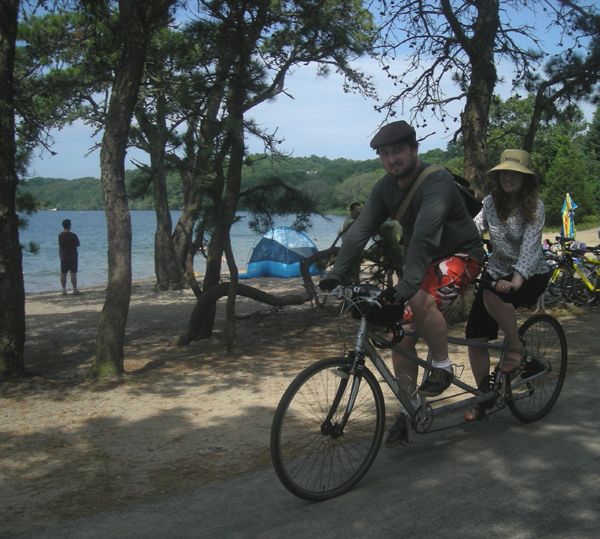
Over the weekend we wanted to take our bikes to Cape Cod and cycle on theRail Trail. Unfortunately, our lighter bikes are at the shop and the Pashleys are too heavy for the car's rear rack. Browsing the rail trail brochure, I noticed an advertisement for tandem rentals. Tandems! Within seconds, I was making a reservation.
Our tandem was a modern Fuji mountain-road hybrid, with an aluminum frame and carbon fork. With our mismatched beach attire and sunscreen-streaked faces (it was a
hot day) we didn't exactly look glamorous, but it was quite an experience!
Tandem bicycles look charming and fun, which makes them seem easy to ride. I assure you that they are not! Despite Sheldon Brown's detailed description, we did not expect it to be so challenging. The tandemists must learn to coordinate their pedaling and coasting patterns, pedaling cadence, and even their body movements, so as not to disbalance the bicycle by leaning in different directions. This takes some time! Steering, shifting gears, and turning corners require considerable skill.

The person at the front of a tandem is called the Captain, and the person in the back is the Stoker. The job of the Captain is to steer and balance the bicycle, and to control the gearing. The job of the Stoker is to provide extra leg-power on the pedals and maintain the balance.If you are the Stoker, the Captain's back will be your view (inches from your face), unless you turn to the side!
The Co-Habitant was a natural captain and could even ride the tandem stretched out from the rear pedals.

I could not, but I was a good Stoker!
One of the benefits of a tandem, is that it can go very fast. Once we got the hang of operating the bicycle, we were
flying on that thing, grinning with delight and leaving other cyclists in the dust. Overall, I prefer to ride an individual bicycle, simply because I like the control and independence. But on occasion, a tandem would be so much fun. It's a tandem!
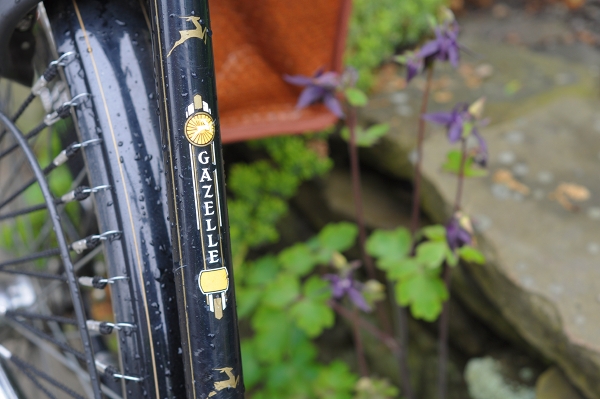 Since Linda began a new life as an outdoor bike, ithas been raining heavily and continuously. I considered bringing the poor bike back inside, but resisted. In her 15 years of life she has probably seen worse. So I left her outdoors as it poured day after day.
 So what's the damage to a Dutch transport bike after two weeks of being left out in the rain? Well, the main thing is that the front brake has developed a shrill squeal. I didn't know that could happen to hub brakes, but apparently it can. The stopping power is the same as before, only now it sounds like a hysterical piglet. The rear coaster brake makes no noise. Should I somehow lubricate the front hub? We are scaring people at intersections![Update: The front brake squeal stopped on its own as soon as the rains stopped. Works as well as before and just as silently.]
 The other thing is that the leather grips are now completely soggy, since, unlike the saddle, I made no provisions to cover them. I installed these gripsin Octoberand they've been rained and snowed on many times with no adverse consequences, so I didn't think it would be a big deal to just leave them uncovered. But of course when it rains non-stop for so many days, it's a different story. Not sure what to do now other than just wait for the sun and let them dry out naturally. But in the future I should try Bobbin and Sprocket's smart solution.
 Otherwise, nothing on the bike seems any worse for wear. I am especially pleased that my silver lug-lining (done with a Sharpie!)has held up and that the bottle dynamo isunaffected. Now if only it would stop raining!


 Some food for thought for those who believe that all cyclists must do their own maintenance and repairs: Not everybody has the physical strength for it. I've lately spoken to several persons who have sheepishly admitted this, and were then relieved to hear that I have the same problem. My personal weak point is lack of hand and upper body strength, which can result in difficulties with even routine tasks. For example, I am not always able to open the quick release levers on wheels. On some bikes it's easy, but on other bikes I simply can't - no matter how hard I pull. Similarly, tires can be difficult to get off the rim: With some wheel and tire combinations I can work the tire iron until I am red in the face, but it won't budge and the tire refuses to come off. It is frustrating, because with many bicycle repair tasks I can give precise step-by-step instructions to someone else, but just can't physically do the work myself. And it's even more frustrating to watch the Co-Habitant do in 2 seconds what took me 10 minutes of pantingnot to be able to do.
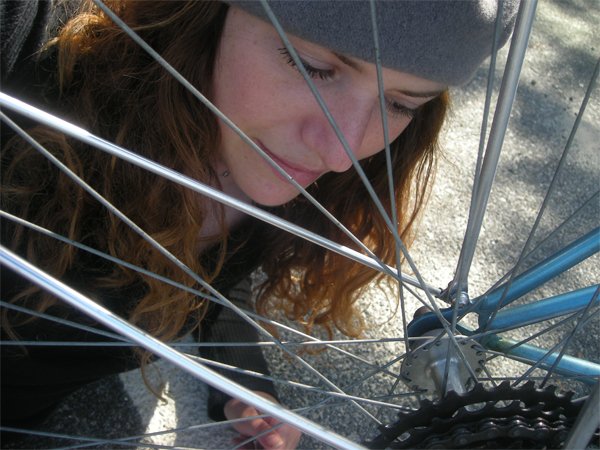 The way I see it, it is helpful to be aware of your limitations and to plan accordingly.If you can't repair a flat, accept it - and be prepared. Buy tires with good puncture protection. Know where all the bike shops are in the area where you travel, in case there is a problem and you need support. Know where the nearest subway, train and bus stations are. Carry a mobile phone, cash and a credit/debit card as a matter of course, in case you are stranded in the middle of nowhere and need to call a friend or a taxi to get you. And most importantly, please don't feel bad if you can't do repairs on your own - you can certainly still ride a bike! We are all good at some things and bad at others, and there is not a thing wrong with that.

 We had this rainbow before the big rain storm last week.