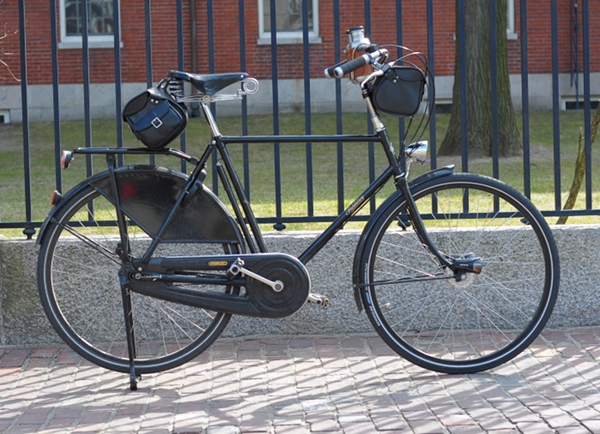
If you are a regular reader, you probably know that the Co-Habitant owns a
Pashley Roadster Sovereign. We bought a pair of
Pashleyswhen I first started this blog, and while I've since sold my Princess, he has kept his Roadster. He loves this bicycle. It is his main transportation bike, taking him to and from work every day for nearly two years now - in sunshine, rain and snow. This review is based on both his and my impressions of the bike.
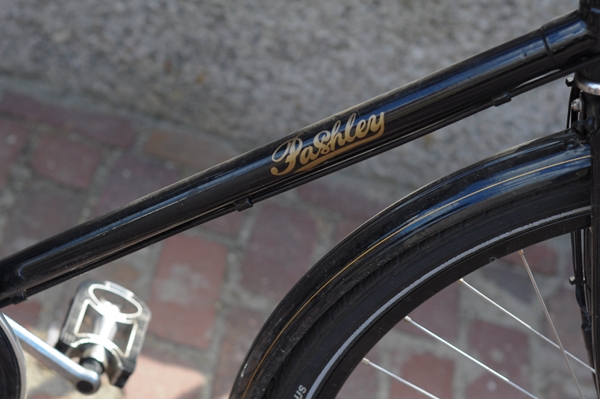 Pashley
bicycles have been made in Stratford-upon-Avon, England since 1926. The Roadster is a traditional lugged steel English roadster frame with relaxed geometry and 28" wheels. It is powdercoated black and fitted with a 5-speed
Sturmey Archer hub, dynamo lighting, and drum brakes. See here for the full specs and here for the complete set of images. This bicycle was purchased in May from
Harris Cyclery in West Newon, MA (not a sponsor at the time).
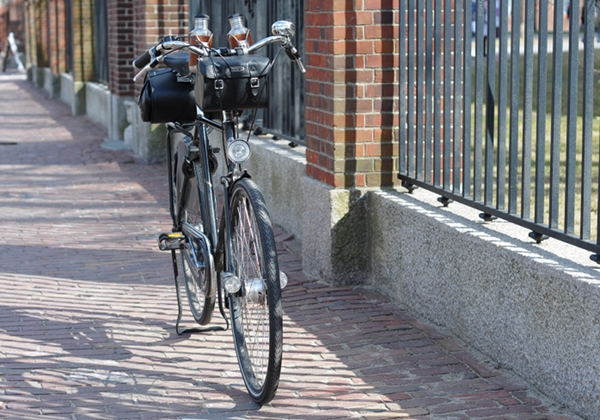
One interesting thing to note about this bike is the sizing. The Co-Habitant is 6' tall and his preferred frame size is normally 60-64cm, depending on geometry. However, his
Pashley's frame is only22.5" (57cm), and yet it is his size. That is because the
Pashley Roadster has an unusually high bottom bracket (330mm), which makes the standover considerably higher than it would be on a typical bike. For comparison, the bottom bracket height on his vintage
Raleigh DL-1 Roadster is 310mm, which in itself is considered high. This explains why the
Raleigh and
Pashley are both his size, despite the former being a 24" frame and the latter a 22.5" frame. When in doubt, go down a size with the
Pashley Roadster.
The
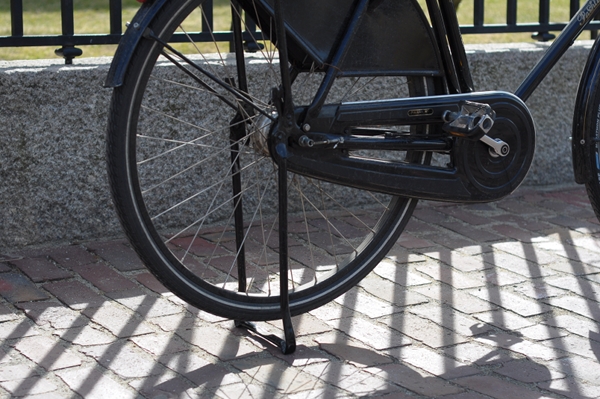
PashleyRoadster Sovereign is a bicycle fully equipped for commuting: generous fenders, full chaincase, vinyl dress guards, large rear rack, drop-down kickstand and an integrated wheel lock. The Co-Habitant finds the dressguards and chaincase convenient, because they enable him to wear pretty much anything he wants on the bike - including dressy clothing and overcoats. He does not like tucking his trousers into socks or wearing ankle straps when riding to work, so these features are important to him. The chaincase has kept his chain immaculately clean through two winters and does not stand in the way of rear wheel removal. For those who dislike the drop-down kickstand, the frame does come with a kickstand plate, so it's possible to install an alternative. Initially, we installed a
Pletcher double-legged kickstand and used it instead of the drop-down, until it broke, so now it's back to the original.
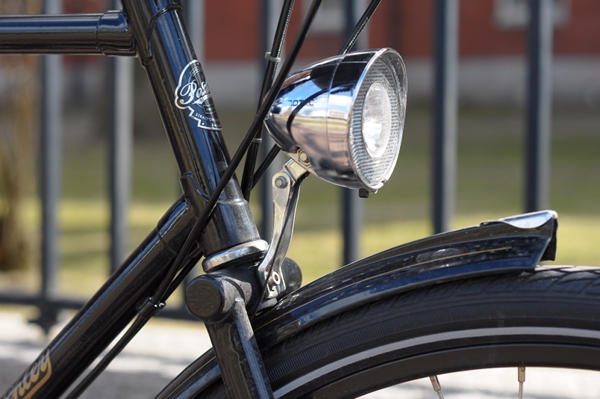
Though the headlight on the Roadster is dynamo-powered, the tail light is battery-operated. The 2.4W dynamo hub makes it difficult to modify this lighting set-up, and we are really not sure why
Pashley chose to do this instead of using a 3W hub and bulb. We are considering eventually replacing the lighting on his bike with a front and rear LED system with standlights. Trouble is, there aren't any classic LED headlights in a style that would suit the
Pashley.
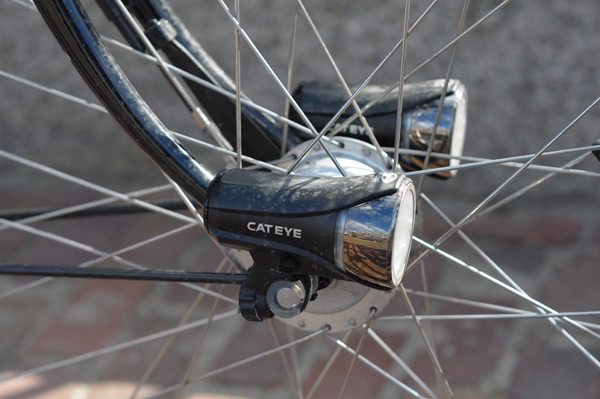
Supplementary
Cateye battery lights attached for situations when visibility is especially poor. The bolts on the
Pashley's front axel make it easy to mount these.
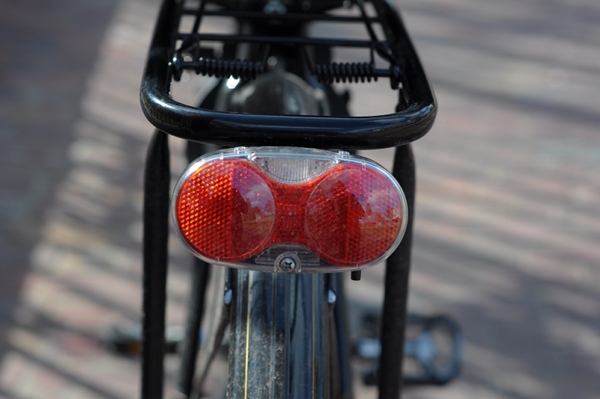
The rear rack is spacious, but made of such thick tubing that most pannier mounting systems will not fit it. The
Ortlieb QL2 and the
R&K Klick-fix systems
sort of fit, but just barely.

Tires are
Schwalbe Marathon Plus. They are not my favourite tires, but the puncture protection is unbeatable.
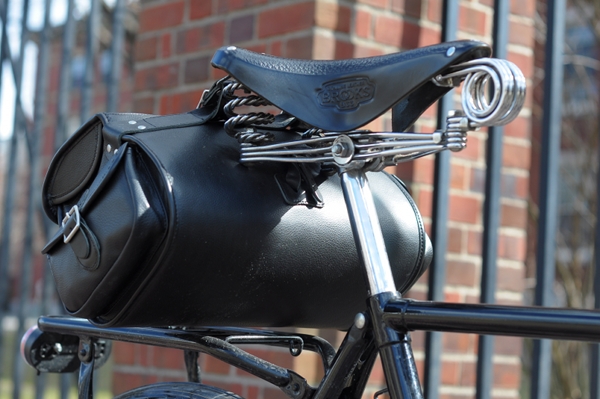
The saddle is the super-sprung Brooks B33 - especially suitable for the larger gentlemen on upright bikes.
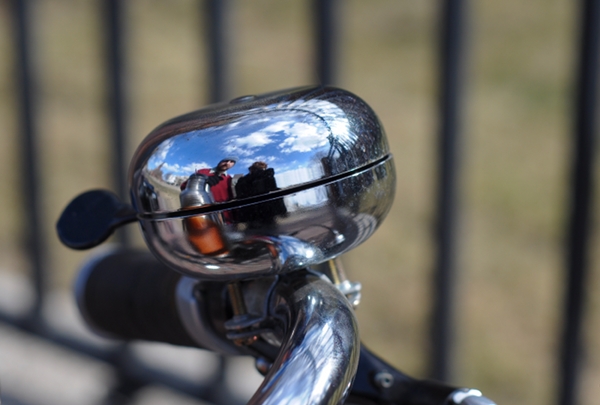
And of course, the shiny "ding dong" bell. That's us, reflected in it.

Though we are both lovers of customisations, there wasn't much that the Co-Habitant modified on this bicycle. All the components have remained stock thus far. As far as positioning, he lowered the handlebars to make them level with the saddle and angled them down a bit, for a more aggressive position. He also shoved the saddle forward by means of reversing the seat clamp. He added a
Brooks Glenbrook saddlebag and Millbrook handlebar bag, which are permanently affixed to the bike. The saddlebag contains his lock, bungee cords and saddle cover in the side pockets, with the main compartment kept empty for quick grocery trips and other errands.
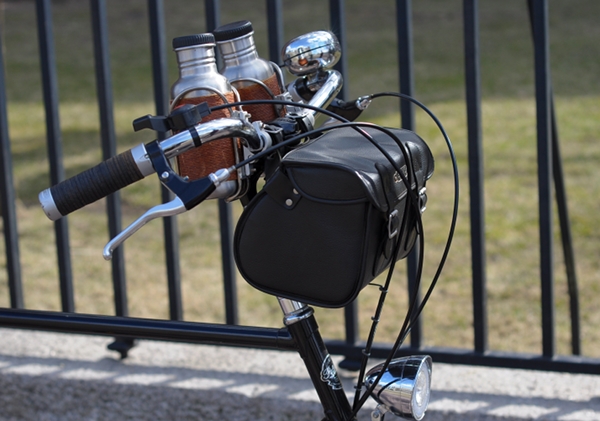
The handlebar bag contains his rain gear, gloves, bad-weather cycling glasses, flashlight, and epic toolkit. The toolkit he carries only on longer trips.
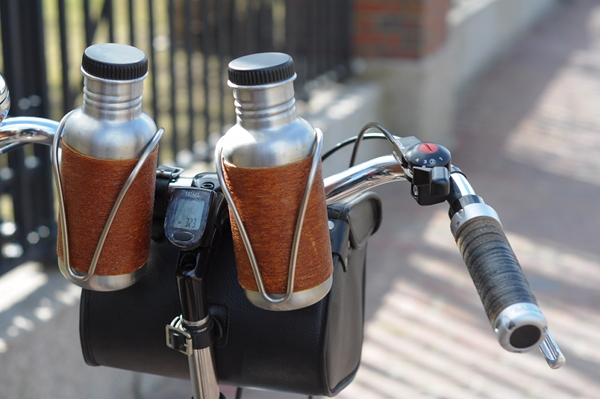
The original plastic handlebar grips were replaced with the
Brooks leather washer grips. Front and rear drum brakes are hand-operated, and he has them routedright-front.And just in case you haven't noticed, the handlebar set-up includes a cycling computer and twined water bottles in their DIY handlebar mounts. The computer is fairly unobtrusive, blending in with the black part of the riser stem.

And a close-up of he bottle cage mounts. The set-up with the twin bottles sticking out like miniature cannons over the handlebars is over-the-top eccentric for me - but over time I've grown used to seeing them on his bike and even find them endearing. He has also carried paper cups full of coffee in those bottle cages - successfully.
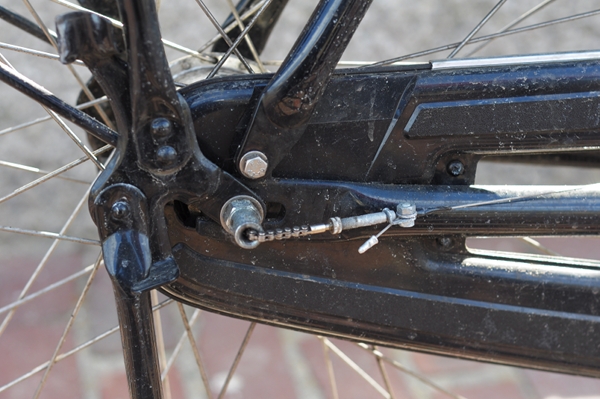
We considered washing the bicycle before taking pictures for the review, but ultimately decided against it. These pictures realistically portray what the bike looks like after a winter of commuting - and a harsh winter at that. The only time this frame has ever been wiped down was after the previous winter. With everything either fully enclosed or stainless, the
Pashley Roadster is as low-maintenance as they get. The powdercoating has held up excellently, with just a few scuffs here and there.Over the time he's owned this bicycle, the Co-Habitant has broken two spokes on the rear wheel (one per year) and had them replaced. The wheels also had to be re-trued a couple of times, no doubt due to the horrible pothole-ridden roads on which he commutes. Otherwise, significant adjustments have not been necessary.
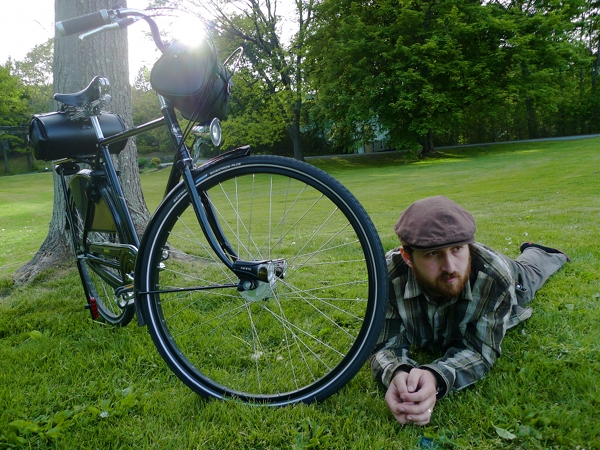
As far as ride quality and subjective feedback go, there is a distinct feeling of the bicycle being stable, reliable and enormous.
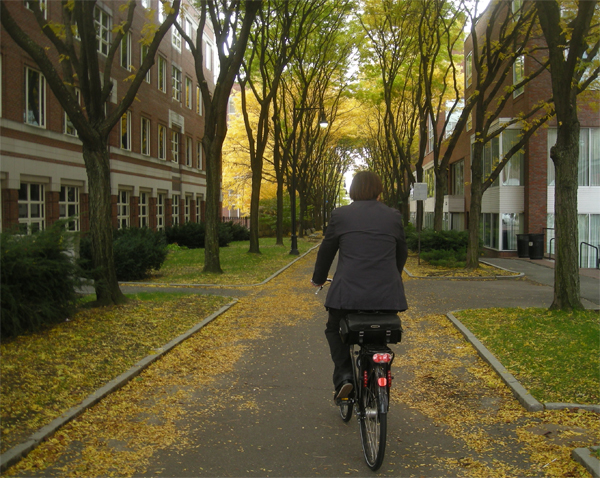
It can comfortably travel at high speeds, with the cyclist feeling relaxed, perched high above city traffic. And this isn't merely an illusion - with the high bottom bracket and the upright sitting position, the height at which the rider is placed really is out of the ordinary.
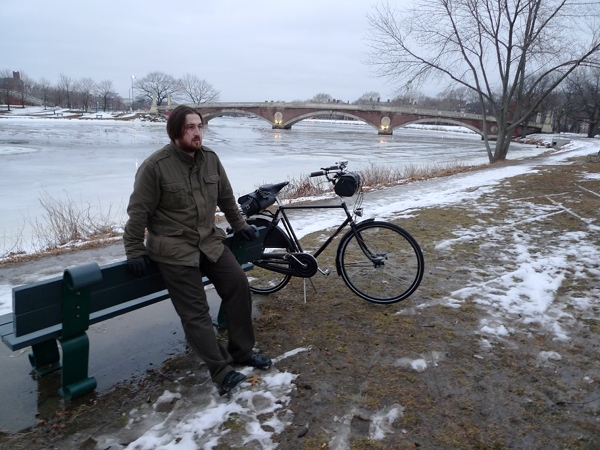
The bicycle handles well on the road and off, in dry and wet conditions.In the winter, it has proven to be a trusty companion.
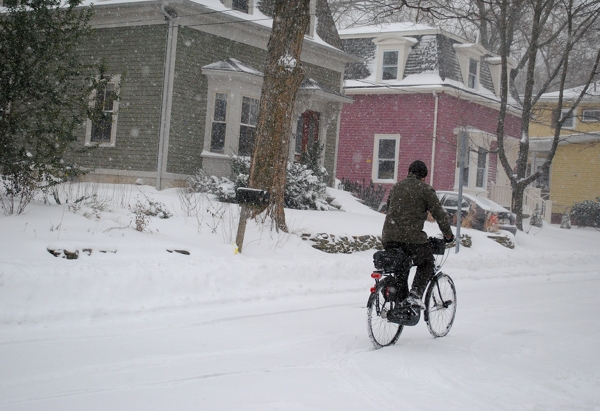
Even during blizzards, the Co-Habitant continued to commute on this bicycle, and felt comfortable doing it.

When describing the
Pashley Roadster's ride quality, it is worth noting that it is
not the male equivalent of the Princess model: The geometry and handling of the two bikes are different. Performace-wise, the Roadster accelerates faster and climbs hills easier than the Princess, which can be problematic for those who buy the two bikes as a "his and hers" pair. Though this discrepancy between the men's and women's models is unfortunate, the Roadster's performance in itself is terrific.

As for my own impressions of the Co-Habitant's
Pashley, I've come to see the bike as his permanent companion or even an extension of his personality. He loves the bike, never complains about it, and uses it daily for transportation, which is fantastic. But sometimes I do wonder whether the bike is overbuilt for his purposes: To me it seems excessively heavy, and I don't get the point of having that monstrous rear rack if it is seldom used for anything other than saddlebag support. Also, it takes great effort to convince him to leave the bike locked up in the city, which is frustrating. At work he has secure locking facilities, but when we go out he worries about the bike too much - which in my view somewhat undermines its usefulness. However, the most important thing is that
he enjoys the bike and rides it, which I feel has been accomplished here pretty well.

Though the
Pashley Roadster Sovereign is not inexpensive by any means, it is a good value once you consider what is included and add it all up: a traditional lugged frame made in England and a fully integrated "commuting package" consisting of fenders, drum brakes, full chaincase, dressguards, puncture-proof tires, lighting, and a high quality sprung leather saddle. After close to two years of daily use, including two New England winters, the bicycle looks hardly worse for wear - a testament to its durability. As with everything, your impressions may differ, but the Co-Habitant is a happy owner. He is not looking for another transportation bicycle for the foreseeable future.
 We took a tour of the lower level of the "big house". The owners still use the upper levels of the house. The house was built in 1936. It is listed on the National Register of Historic Places. The tour guide was dressed in costume and was very friendly and interesting. The TV series North and South with Patrick Swayze was filed here. The movies Queen with Halle Berry and The Notebook were filmed here also.
 The next thing you can visit is the row of slave cabins. They date back to 1790-1810 and are mostly in their original state. These were only some of the slave houses and would have been the workers that held more important positions. The houses were built with bricks that were made here and were evidence of the slaves' skills. Some of the bricks still have the handprints from their makers.

 Some of the crafts were on display. On top of that, a woman was there making some of the sweetgrass baskets.

 We took an open air coach ride to see the fields that are still in operation.
 Our favorite thing by far was learning about the Gullah culture. We first heard the word "Gullah" when we listened to the audiobook "The Mermaid Chair" together. We were honored to sit and listen to Carolyn "Jabulile" White, who grew up on the sea islands.


 The western side of Mount Saint Helens as seen from the Visitor Center at Silver Lake, 46 road-miles away.
 From a viewpoint on the north-northwest side.
 Clouds covered the upper half of the volcano for the entire afternoon with an occasional break, which briefly revealed the peaks. This, and the remaining photos were taken from the Johnston Ridge Observatory. Named for David A. Johnston, a volcanologist on duty nearby on that fateful day. His last words were “Vancouver, this is it!”
 The lateral blast exploded to the north toward what is now Johnston Ridge and, quite literally, destroyed everything in its path.
 The mountains and valleys were tall old-growth forest. Now all that remains are a few denuded logs lying about like pick-up-sticks.

 A park service sign nearby tells a tale of the blast as “spoken” by this stump: “Step up and look at me carefully. Notice my shattered trunk, my missing top. I once stood 150 feet tall, surrounded by a beautiful forest of green and growing trees. When the blast exploded sideways out of the mountain, it plowed through the debris avalanche and swept across the landscape, picking up and carrying large chunks of rock, ice, and splintered wood.”
 Down in the valley, the blast dumped 680 feet of debris, filling Spirit Lake to the east with logs and ash.
 Johnston Ridge was completely denuded. Spirit Lake lies beneath the far ridge at left-center and St. Helens rises up from the valley on the right.
 The early evening light emphasizes the ridges and the gulleys now being carved out by the flow of water.
 Another view of cloud shrouded St. Helens from Johnston Ridge in the early evening. All photos were taken on Sunday, September 12th.



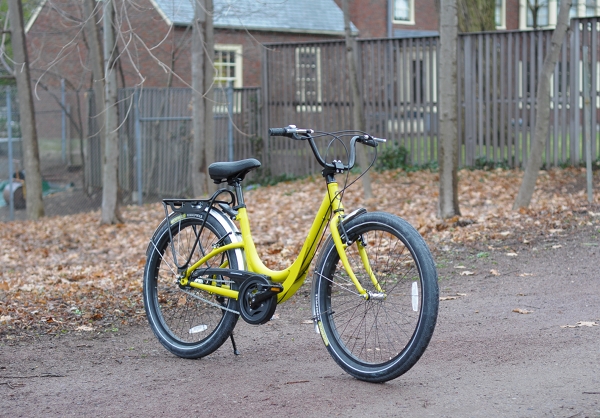 The past couple of days were rainy and dreary, and I've been sick in bed. Still, I managed to crawl to the door when the bell rang, and take delivery of an enormous package from Urbana Bikes - a Canadian manufacturer that has asked me to review this unusual creation. I opened the box and nearly jumped back from the burst of colour that greeted me. I'd requested a bike in "olive," which on the manufacturer's website looks like this. In person it resembles an exotic poisonous mushroom. "Oh boy, I should have asked for black!" was my initial thought. But as I continued to stare, the neon shade began to grow on me. At least it offered a cheerful contrast to the dark gray skies and pelting rain outside. I dragged the bike outdoors for some quick snapshots, half-hoping the rain would mistake it for the sun and stop... and believe it or not, it did, if only for a few minutes.
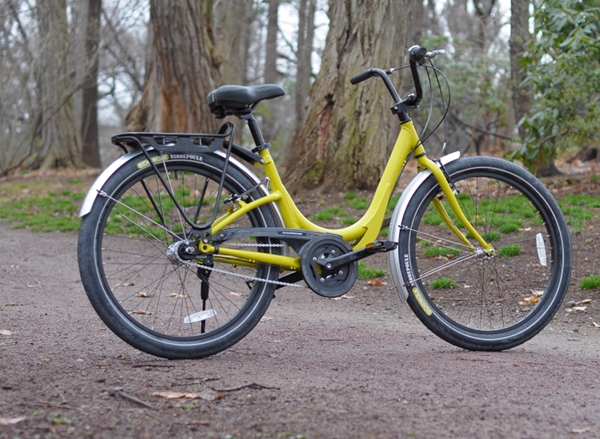 The Urbana bicycle is a rather extraordinary cross between a BMX bike, a mountain bike, and a Dutch transport bike with large hauling capacity. But I will elaborate on all of that once it's time to review it. What struck me today, was how remarkably vibrant the "poisonous mushroom" colour looked in rainy weather. I walked away from the bike, stood to the side, turned around partially - but as long as it was even peripherally in my field of vision, it commanded attention. I look forward to comparing my experience in traffic on this "hi-vis" bicycle, to my own, neutrally coloured bikes.
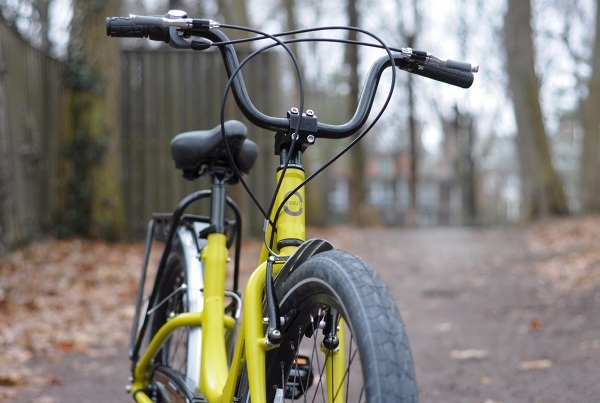 We are still in the process of adjusting the bike's components and I was not in a condition to cycle yesterday anyhow, but I will share my impressions once I begin to ride it. This is the first time I'll be reviewing a bicycle that isn't mine beyond a single test ride, so it should be interesting. I am still ironing out the logistics with the manufacturer, but after my review the Urbana will go to a new home.
 Normally I am not a fan of hi-vis anything, but I make an exception in inclement weather and I think that neon bicycles would make good "rainbikes."How many of you ride brightly coloured bikes - either because you prefer the colours, or for the sake of visibility? And do any of you have dedicated rainbikes?