There is not much information available about Sneek’s medieval water port or gateway (located in Sneek, Friesland in the north of the Netherlands). It was believed that the port was built around 1492 by an unknown architect and its primary function was to control the water flowing into the town. Back then cities and towns are built around thick stone walls for protection from enemy invasion, and in the Netherlands because of its quagmire topography, they make use of the water as moats, serving an additional line of defence.


I saw this poem engraved on a block of stone, written in Fries by Marcel van der Meulen on the trattoir just beside the water port. Fries is a language spoken in the northern part of the Netherlands, primarily in the Friesland province where Sneek is a part of. It is a bit similar to Dutch of course so I can understand some of it (written but not spoken) but not all.
Here is my meagre English translation (in Fries or Dutch they actually rhyme but not in English, too bad):
Butter, bread and milk in our cup
Who cannot say this is not a real Sneker
I am though, because I live in the Water Port
There in ‘hewwe jim’ it was heard (this line I am having a hard time translating, help!)
It is a very old building that I adoreBoats, canals and the citySneek will always be my biggest loveAnd here are a few more fotos of the famous Sneeker Waterpoort:


In Madurodam (The Hague), the mini-Holland park or the smallest city in the Netherlands, there is a little replica of the Sneeker Waterpoort, scaled down to 1:25. I think I even have a foto of it, hmm, need to search my archives. Other replicas are to be found in China (Holland Village in Shenyang), Japan (Huis ten Bosch in Nagasaki) and Denmark (Legoland in Billund).
Many say that the Sneeker Waterpoort, one of the great examples of medieval architecture, is the Netherlands most beautiful water gateway. I quite agree.
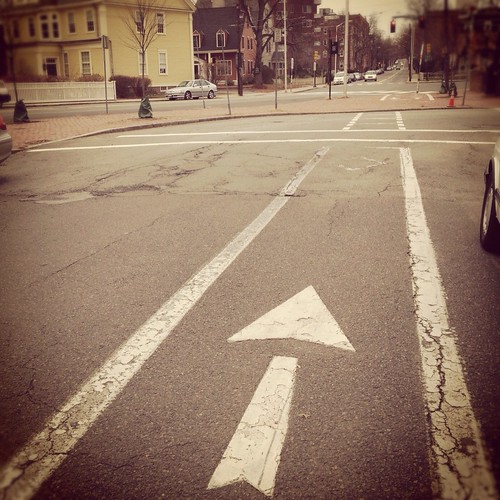 Walking around on Christmas day, the streets are almost completely abandoned. This offers a rare opportunity to observe during daylight hours how things are laid out. I cycle past this particular intersection several times a week, but always approaching from the other direction, and it is usually very crowded. So I've never fully processed its design from the opposite direction until now. And the design is really something. I don't know how well my pictures demonstrate this, but there is a bike lane running against traffic that guides cyclist directly onto a brick island at the intersection.
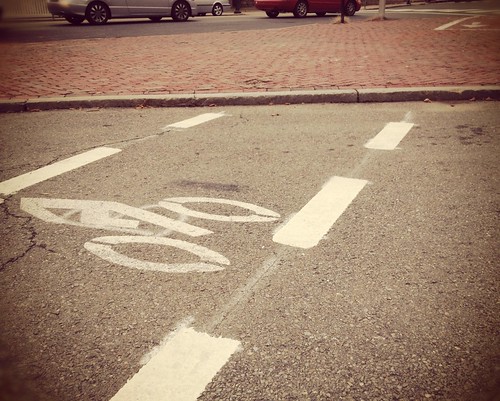 Once the bike lane reaches the island, there is no entry point. But the markings invite cyclists to hop a 4-5" curb, at an angle. Some of you are probably thinking "Well okay, I can take that at speed on the right bike." But wait, not so fast.
 There is a bicycle stop sign just before the intersection, so you really don't have that much room to accelerate. In addition, remember that this bike lane is against car traffic, so you also need to watch the blind turn as you make your way toward that 5" curb. I am no expert, but this might be worthy of some sort of "cycling infrastructure fail"award. And it certainly explains why I see confused, flailing cyclists approach the intersection from this direction whenever I cycle through here.
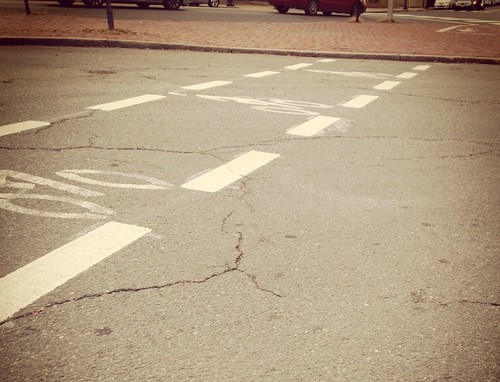 Lately I've been reading Brown Girl in the Lane's delightful rantsabout Vehicular Cycling advocates. She considers these fellows to be the "spawn of Satan" because they are against cycling infrastructure. Of course, their reasoning is that they are against it precisely because the sort of thing pictured here is what cities will do to cyclists when designing said infrastructure. Carving out a middle-ground position in this debate is tricky and I am not going to try right now. I only wonder whether there is a way to put a system in place whereby those who design cycling infrastructure (1) are required to consult with experts who are actual cyclists, and (2) have some accountability over the type of layout they create. We should not have to choose between harmful infrastructure and no infrastructure at all.


 I couldn't visit the New England area without taking pictures of at least one covered bridge. Unfortunately, we only saw one that I could take a picture of. It was an awesome one though! If you click on the picture above, it tells how it is the longest wooden bridge in the US and some other history.
 This alone made the visit here worth it! The river separates Vermont and New Hampshire.
 I love what it said above the bridge too.
 Isn't it just beautiful here? It's like a fine painting everywhere I look. I am enjoying our time here so much!


 When I was a child my mom always wanted to know what kind of bird it was that made a noise that, to her, sounded as if it was saying 'come here, come here'. Since she thought it sounded like it was saying that I have always thought so, too. We could always hear the bird but could never get a good look at one. Usually we only hear this bird when we would go camping, or hiking in the mountains or desert. Since we have moved to the Tumbleweed Crossing I have discovered what the bird is. It is the Ash-throated Flycatcher. There are lots of different flycatcher birds all over the world and several different kinds in the US. All are similar and I didn't know what the proper name for our kind of flycatcher was until recently when I finally found it on the internet. These interesting little birds are kind-of built like a swallow only larger. They are mostly grayish on back, wings, head, and tail, but have a dull yellowish color to their belly area. Males and females look alike. They disappear in the fall and winter. I assume they migrate south probably to somewhere in Mexico. But the come here to nest. I usually have one or two pairs near my house each summer. They usually build their nests in a cholla cactus just on the edge of our property but this year they built in a cottonwood tree next to the horse pens, and hay shed. Every time I walk by it they fly off yelling 'come here, come here'. But return quickly and watch what I am doing as I feed, water, or pet horses. I had seen the nest before I knew which bird was using it. I had thought it might be an English sparrow nest as it had so many pieces of string, paper, tumbleweed sticks, and a piece of cloth in it. It was a couple of days before I actually saw a flycatcher on it which can't be seen in the photo of the nest. I welcome all flycatchers as they eat lots and lots and lots of flying insects especially flies which is where they get their name. I have seen them perched on a tree or power line and suddenly fly down to scoop up an unseen insect and then back to their perch they go. They will do this over and over. They come in to the water I keep in hubcaps in the back yard each evening.

