
(Photo: Gail giving Dis-Mantel (5.10b)a try.)
Did I mention that I am on vacation?
I am at the beach. I cannot go rock climbing.
But I am going to try to catch up on my posting.
I have been on the hunt for the easy 5.10 climbs at the Gunks. The climbs on the Mantel block seemed like maybe they would be good candidates. They are short climbs up the sixty-foot block, with roof cruxes.
But those one-move cruxes can be stiff for the grade. I was also worried that these climbs might not be very good, a waste of time.
I had bugged Gail to do these climbs with me for the last few months. We finally got around to them on Friday.
I decided to start with Dis-Mantel, the climb on the right. From the ground it seemed to me that I could get pro in the flake at the first, 5.10b roof. And I thought I might have better luck on Dis-Mantel than on the climb to the left; the roof on Dat-Mantel looked incredibly large.
the early moves up to the first roof on Dis-Mantel were simple enough. But the pro in the flake at the lip was kind of iffy. I got a green Camalot to sit in there but I wasn't absolutely sure about it. I had a rock solid piece back where the roof met the wall but I wanted something higher. There was absolutely no pro up over the roof.
I can't remember if I ever really tested that green Camalot. What I do remember is that I couldn't figure out the move at all. I kept going up and climbing down, trying this and trying that. There was a good hold that was very very far away. I'd read that the climb was height-dependent but this was ridiculous. I couldn't figure out how anyone could reach it. I tried under-clinging the roof, I tried using the flake as a side pull. I tried holding on to various parts of the shallow left-facing corner above the roof. I tried using a little fingerlock seam below the jug. Eventually I decided to give up, climb down a few moves and try Dat-Mantel to the left.

(Photo: Getting the holds above the lip of the roof on Dat-Mantel (5.10b).)
I found a few interesting moves on my way over to the Dat-Mantel roof. I was still below the roof, confronting a thin move up an orange face, when I realized that I didn't have any of my big cams. I'd left my blue # 3 in my bag and I'd somehow used both my red # 1 and my yellow # 2 below. I could see that I needed at least one bigger cam for the horizontal beneath the roof. And who knew what I might need above?
I was trying to decide what to do about this problem when it started raining.
This was the excuse I needed. Things weren't exactly going in my direction anyway. I decided to bail. I backed up my top piece and had Gail lower me, thinking when the rain stopped one of us could go up Unnamed, the climb that ascends the left side of the Mantel block at 5.0, to set up a top rope and retrieve the gear.
When I got to the ground the rain stopped before it even really began. So I led up Unnamed, a climb that has a 5.3 second pitch above the Mantel block. The first pitch, which goes up the left side of the block, is just 5.0. It isn't bad climbing for 5.0. It's better than Dirty Chimney, for sure. The pro is a little funky. There are big vertical cracks but they are flaring. At one point there are three old pitons hammered into one crack, right on top of one another. Maybe they were put in as practice placements, forty or fifty years ago?
Up atop the block is a stone with several ratty old slings and a couple of newish ones threaded. This anchor is well placed for Dat-Mantel. You don't even need a directional.
Gail took the first stab at Dat-Mantel on toprope. She looked a little shaky at the thin move up the orange face below the roof, where I had given up the lead. Then I got the benefit of watching her figure out the huge overhang, which surely helped me when it was my turn. Still, I was happy with how it went when it was my turn. I figured out an easier way to get through the orange face. And I went at the roof a little differently than she did. She crimped up to the horizontal above the roof using some holds that looked truly awful. I had a notion that it would be easier to get up there if I moved a little to the right and this turned out to be a good call. Then I threw a heel, pivoted up, and presto-- I had done it on the first try.
Dat-Mantel is a nice little climb. There are a few nice moves below the roof, and then the roof itself is a good challenge. It is well-protected, too. There is a good slot right where the underside of the roof meets the wall, and then once you get the horizontal above the roof, but before you attempt pulling over, you can get another solid placement. I wish I had been more insistent on going ahead with the lead of this climb. If I'd tried it first instead of Dis-Mantel maybe I would have done it.
I hope to go back this year and send Dat-Mantel on lead.
Dis-Mantel, on the other hand, remains a mystery, and I don't think I will be heading back to lead it. Neither Gail nor I could figure it out, even on top rope. (We set it up from the same threaded station, using a directional placement.) And I'm still not sure how I feel about that cam in the flake at the crux roof. There aren't any cracks for pro above the roof, so even if the cam in the flake holds I don't really like the thought of the fall at that roof if you blow it on lead. The second (5.8) roof also looks to have funky pro. Each of us tried it on top rope by cheating around the first roof to the right, doing the Kernmantle crux before heading left to the second Dis-Mantel roof. Gail had no problem with the second roof but I was so hot and tired by the time I got up there that I blew it once before pulling through it on the second try.
If someone would take me up Dis-Mantel and show me what I'm doing wrong, I'd appreciate it! I still feel reasonably good about the effort. I was safe about it, explored around the roof without losing control, and climbed down when I correctly decided I was out of my depth.



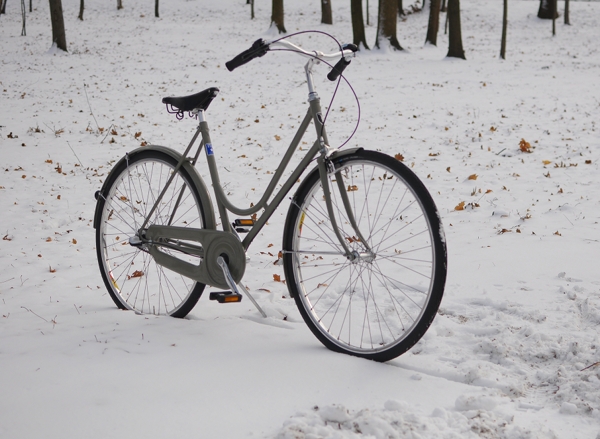 I have been looking forward to testing myBella Ciao ("Patricia")in winter conditions, and with the arrival of the season's first snow I finally got my chance. Before I go on, I will preface with the disclaimer / mini-announcement that I have begun collaborating with Bella Ciao on a special edition bicycle, which will be sold by Harris Cyclery in Spring . I will have more details about that soon, but just wanted to make that affiliation known in the meantime.
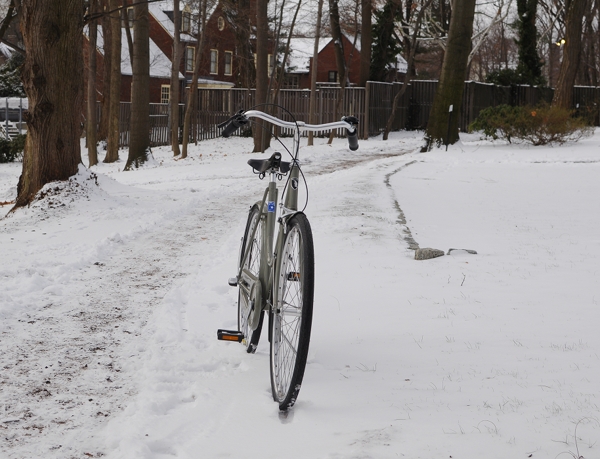 Though I love the way my Bella Ciao "Corvo Citta" model handles, I don't ride it as often as I'd like, because I haven't yet installed a rack and lights. Now that winter has begun in earnest, that will be my next project - I just wanted to first make sure that I'd actually be able to ride this bicycle comfortably in snowy conditions.At just over 30lb, the Bella Ciao is considerably lighter than the likes ofGazelle and Pashley, and - justifiably or not - I am weary of lighter bikes when it comes to cycling in poor weather. To my relief, I had nothing to worry about and Patriciahandled just fine after the first snowfall: She remained stable on slush, on slush mixed with salt, and on thin layers of packed snow.
 As with other bikes I have ridden in such conditions, I switched to a lower gear and went slower than usual. The bicycle remained sturdy and cooperative. When braking in slush, I used the coaster brake only, which I find easier to modulate on slippery surfaces. The bike also did well cycling on the slippery stretch of brickwork that was part of my route. As far as safety goes, I feel comfortable using the Bella Ciao as a winter commuter in Boston and will get on with the lights/ rack installation so that I can use it more this winter.
 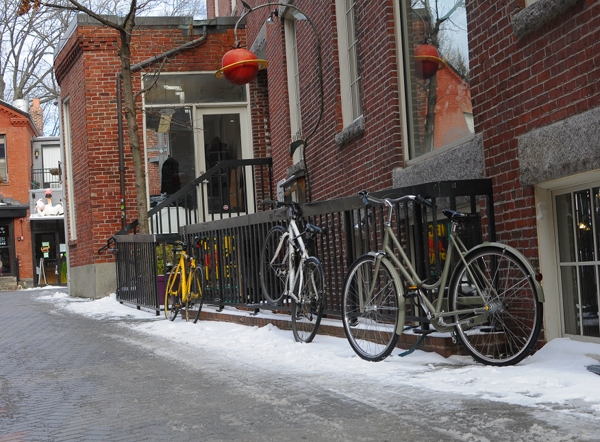 While the brave Patriciaperformed admirably, my first snow commute of the season was not entirely stress-free. Driver behaviour was chaotic and there were few cyclists out on the roads. Several times, I got spooked by a car's ambiguous maneuvers and ended up cycling through a mess of wet snow by the curb. Based on last winter's experience, I know that things will get better once drivers get into their "winter mode". Meanwhile, perhaps there is a reason why most cyclists seem to have chosen to wait it out!
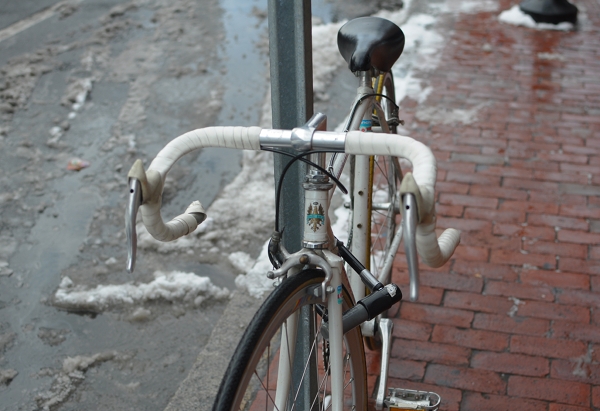 What I found fascinating about the Boston "bike scene" last winter and also noticed yesterday, is that often the only bikes on the streets seem to be those that are least suited for winter cycling - for instance, aggressive roadbikes with narrow tires and no fenders. Where are the fully equipped city bikes? Where are the rugged vintage 3-speeds?
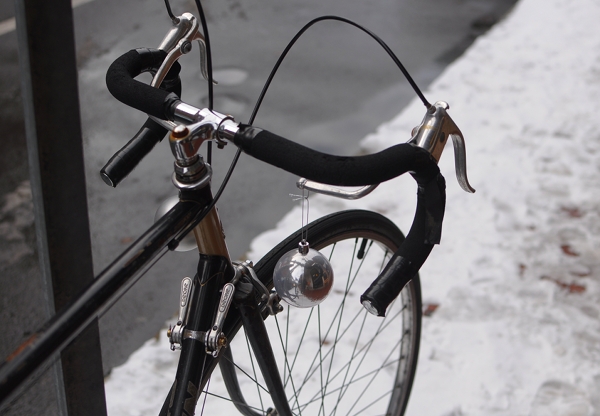 It could be, that the aggressive roadcyclists are the ones most likely to brave these conditions, while, ironically, having the worst possible bikes for doing so. That's too bad, because winter is the time when features like fenders, stable handling, wide tires, internal gearing, and an upright sitting position, really make themselves felt. Last winter, I was extremely appreciative of the Pashley I used to own, and this winter it looks like I will do equally well on the Gazelle and Bella Ciao.
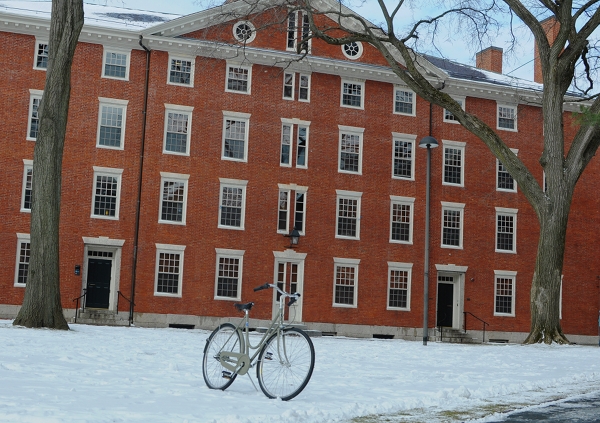 Though Patricia and I did not have many companions on our first snowy commute of the season, we hope that the winter wonderland will coax more cyclists outside soon. Once the drivers calm down, it is really not so bad: Just take it easy, dress warmly, ride a sturdy and properly equipped bicycle, and enjoy the beautiful landscape!
