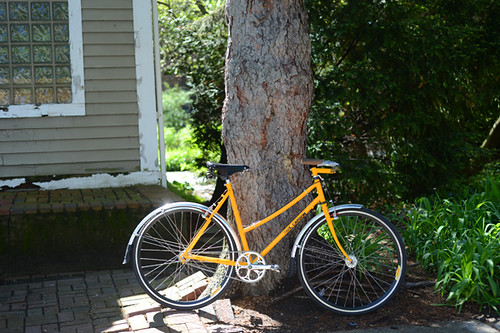
As I stood composing this shot, a woman passing by with grocery bags stopped beside me. Looking at the bicycle, she tilted her head to the side and smiled. "That bike!" she said, "It looks like... happiness." It was a funny outburst, no doubt inspired more by the sunny day and the quaint tree-lined street, than by the bicycle itself. But I knew what she meant. Because this particular bike fit into the idyllic backdrop perfectly. Simple, friendly and inviting, it looked like no more and no less than what it was - a yellow bicycle on a beautiful summer morning. Maybe Paul is onto something here, I thought.

Even though Paul Carson makes bikes and teaches others how to, I do not really think of him as a framebuilder. He is more of an engineer, an experimenter, a problem-solver. Paul doesn't see what he does as a craft, but as production that he loves to simplify and optimise. You might not find him polishing frame joints for hours on end. But you will find him making ridable prototypes with speed and ingenuity ...as well as the tools, fixtures and parts to facilitate doing so. In a sense, Paul is like a magic genie who can turn wishful thinking into reality, and fast. On one occasion, I watched him make a rear rack in under 20 minutes, so that he could try out a pannier on his roadbike. Another time, I wondered how difficult it would be to make a double-plated fork crown from scratch. He asked me to elaborate. I explained and showed pictures. He thought about it, then ducked into a corner. Hack-hack-hack. File-file-file. Flames! Flames! "Like this?"

And there it was - double-plated fork crown for oval blades, spaced for a wide tire, just as I described. "Glad you like it," he shrugged. "I'll get a batch of these machined." That's Paul Carson, in a nutshell.

Unlike most other local builders, Paul is not part of the racing scene. He isn't even really part of the local bike scene so much; he is just his own entity.Perhaps that is why he gravitates toward making city bikes. City bikes have an immediate and obvious utility. And it is fun to see them cruising around the neighbourhood, ridden by ordinary people, carrying milk and potted plants. Over the past months, we've been discussing some ideas for step-through designs. We both like the feel of old English 3-speeds and we also like low trail. Wouldn't it be great to combine these? While our ideas diverge when it comes to wheel size and exact geometry specs, overall Paul's idea of a great step-through is not dissimilar to mine. When he asked me to tryhis prototype, I was eager to give it a go.
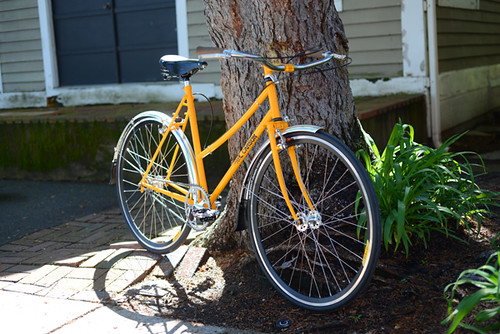
Made of touring grade cro-moly tubing, the Paul Carson Step-Through is designed around 700C wheels with up to 35mm tires and fenders. Ithas a gently curved top tube, and is proportioned so that the handlebars can sit at or just above saddle height. 72° head tube angle and 73° seat tube angle. Trail in the mid-40s.
These framesets will be made to order in a range of sizes and with a menu of options, with prices starting at $650 for a TIG-welded frameset with standard (lugged) fork crown, made for caliper brakes. The price includes powdercoat in a range of standard colours and a headset. Extras include the option of fillet-brazed construction, handmade double-plated fork crown, handmade stem, and cantilever/ v-brake bosses. Turn around is 4 weeks.
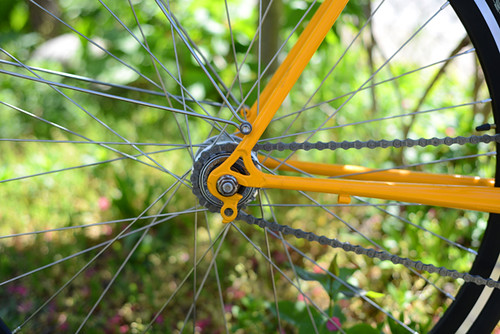
Paul designed this frame with versatility of build in mind. Semi-horizontal dropouts make it possible to use either derailleur or hub gearing. The bottom bracket height (300mm with 28mm tires) is sufficient to set up the bike as a fixed gear. Braze-ons include eyelets for racks and fenders.440mm chainstays are long enough to carry panniers without heel strike. And the front-end geometry will handle a front load.

The demo bike I tried was built in size 55cm and with all the extra options. Fillet-brazed joints, smoothly finished, but not fussed over.

Canti-lever bosses and cable hanger.Twin plate fork crown.
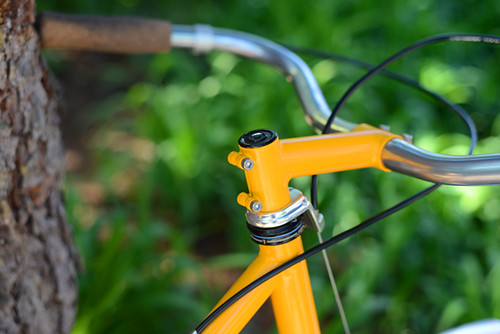
And fillet-brazed stem (threadless).

Paul set this bike up with 28mm tires and fenders, a single speed drivetrain,
 swept-back handlebars with cork grips,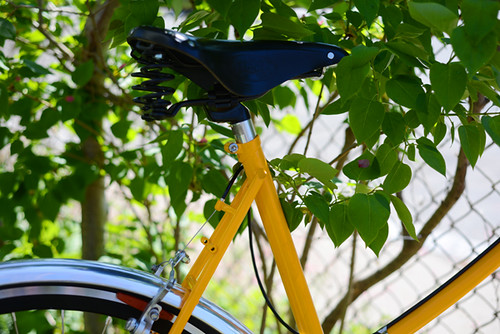
and a Brooks Flyer saddle.
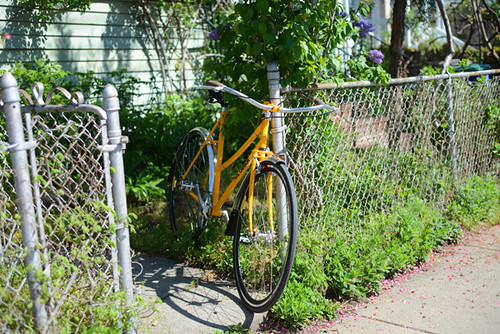
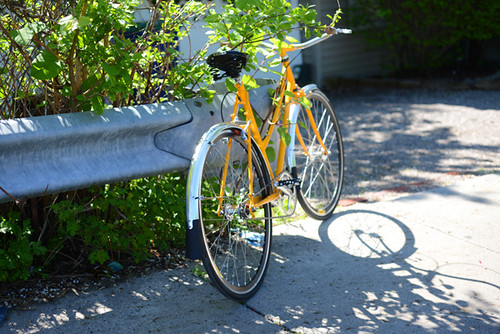
Leaving my own bike at the Asylum, I rode the Step-Through around town in the course of the morning, simulating some of my regular routes. When I struggle for something to say about a bike's handling, that generally strikes me as a good thing - as it means nothing is "wrong" with it. Paul's bike felt familiar, natural, normal. It also felt casual and accessible, more like a cool, repainted vintage bike than a new handmade bike. And it really did look oddly at home in our neighbourhood.
The fit worked well for me, with a more aggressive posture than a fully upright bike. There was no toe overlap with the size 55cm frame and 28mm tires with fenders, though it was close. The steering felt responsive and intuitive. My own city bikes are low trail (under 30mm) and this bike handled like a more neutral version of them.

As far as nit-picks, the step-over height could be a bit lower for my taste. And in my view, a practical city bike (especially for a pothole-ridden neighbourhood like ours) would ideally be specced with 35mm wide tires minimum, not maximum. This is where a smaller wheel size might be worth considering, especially if toe clearance is a priority. Personally, I also prefer lower bottom brackets. But I know that some riders like to feel as if they are "sitting high in traffic" on their bike, which the higher bottom bracket accomplishes.Otherwise, not much else to criticise;I liked the bike.
Paul Carson is an exciting person to know. He has ideas about streamlining the framebuilding process to make handmade bikes more accessible, andI will be following his work with interest. Made in this vein, the Carson Step-Through is not meant to be an artisanal show-stopper. It is a cute, friendly, ridable bike, with a friendly price, handmade in Somerville MA.
 In Belfast Harbor. Getting ready to head out.
 Looking out into the open ocean. Islands off in the distance.
 Lobster trap buoys and the kayak paddle.
 Two hours later, heading back towards the harbor.
 Me and my cousin!
 These two ladies areIsha Ware and Caroline Robinson, from the neighborhood, and they reminded me of why I like bicycles in the first place.
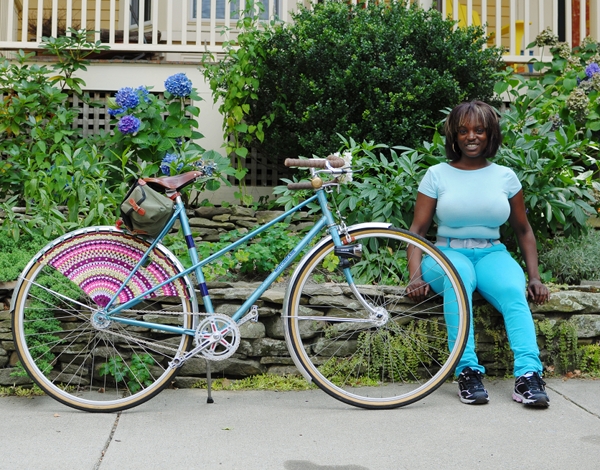 Today I fitted my bikeMarianne with a very funky new set of dressguards (from Simeli) and dragged her outside to photograph. On three separate occasions, women walking down the street stopped to ask me about the bicycle. They were clearly happy to see such a bike - eccentric and undeniably "girly", with a colourful "thingie" on the wheel, flowers on the handlebars, and a shiny bell. Isha (pictured above) was wearing an outfit that was the exact same colour as Marianne's frame, and so naturally this had to be documented.
 One young woman (not pictured here) told me that she wanted to buy a bicycle, but found bike shops to be male-oriented and intimidating. I remember lots of stories like this from 1-2 years ago, but I thought that things were a lot better now. Apparently they are not completely better; at least not yet. One of my main goals for Lovely Bicycle, is that ladies who have been disappointed or intimidated by bike shops can find the information they are looking for here.
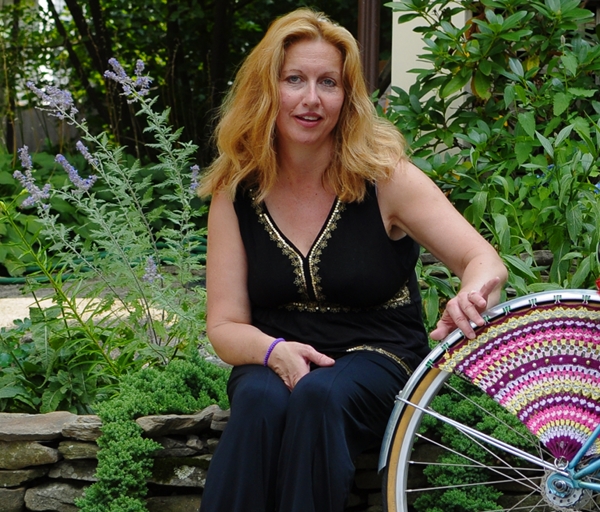 A nice bicycle can make even people who are not into bicycles at all - just people who are passing by - smile and want to pet it. The very form of a nicely designed bicycle is welcoming; the texture of its components inviting. Maybe it's a "woman thing". Or maybe it's universal. But it sure is nice. Lovely bicycles for all!


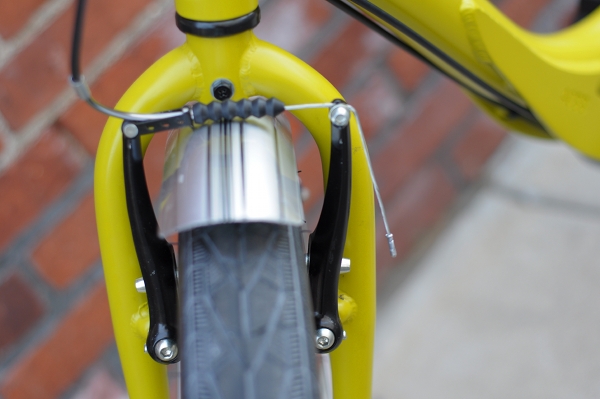 Those who have been reading this blog for some time, are no doubt familiar with my rants against unicrown forks. "The bike is nice... if it weren't for that unicrown fork," and so forth. When the topic comes up, some agree, others question my fixation on this detail, and others still want to know what a unicrown fork is. Now that I am temporarily living with a unicrown forked bike, the time seems right to elaborate.
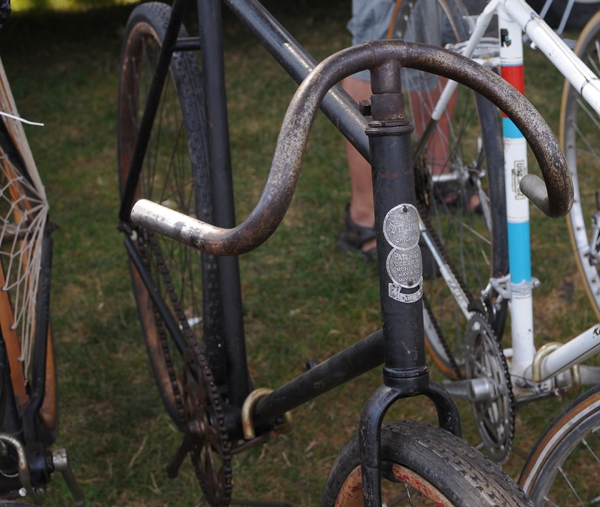 For some time now I've been trying to figure out the history of the unicrown fork, and I keep reading about the first mountain bikes, BMX bikes, and the quest for rigidity - suggesting that its origins were in the 1980s. But then I see antique bicycles- like this ancient Sterling pathracer at the Larz Anderson show last summer - which to me look like they are sporting hundred year old versions of unicrown forks. I have also seen what I can only describe as antique crownless flat-top forks - which appear to be similarly constructed, but are squared-off, rather than round. Would someone care to educate me on their history?
 The thing about unicrown forks, is that I don't actually dislike them per se, at least not in of themselves. What I dislike is when they are incongruent to the overall design of the bicycle. On a welded frame, a unicrown fork looks perfectly natural - integrating harmoniously with the bicycle frame. Just like I prefer lugged frames to welded frames, I similarly prefer lugged forks to unicrown forks. But objectively speaking, a unicrown fork looks fine on a welded frame - like on the D2R Boogie above.
 Unicrown fork on a welded DBC Swift, also looks appropriate. The frame joints and the unicrown fork match, and all are filed equally smoothly.
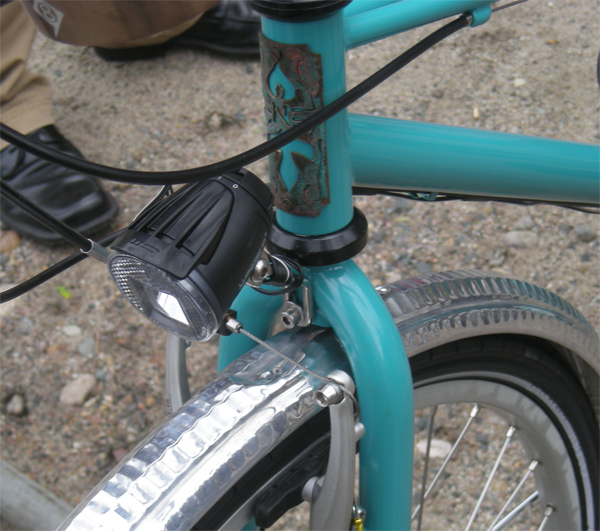 Unicrown fork on an ANT mixte. Now, if I were getting an ANT, I would opt for his segmented fork or his dual-plate crown fork - just because I prefer those styles and they are kind of his specialties. But I don't think there is anything inherently wrong with ANT using unicrown forks on TIG-welded bikes - again, the overall design is harmonious.
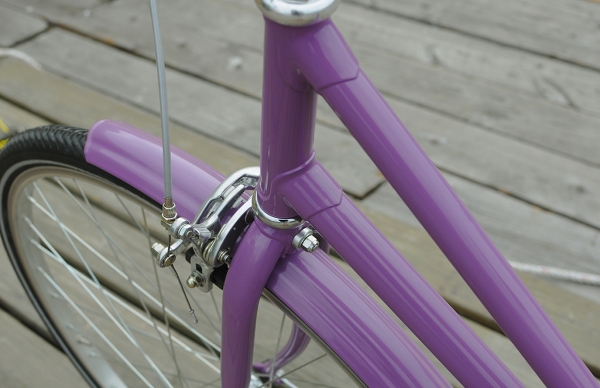 The only time a unicrown fork actually bothers me, is when it is attached to a lugged frame - which is done quite frequently nowadays. Azor/Workcycles puts unicrown forks on their lugged frames, as do Batavus, Velorbis (balloon tire models only) and Abici (above), just to name a few. The reason is most likely a cost-cutting measure, undertaken perhaps with the hope that most customers simply won't notice. And it bothers me, not because I think that unicrown forks in themselves are "bad," but because I feel that a traditional lugged bicycle - especially when the manufacturer takes pride in describing it as such - calls for a traditional lugged fork. When the frame is lugged but the fork is not, the overall look of the bike comes across as disjointed to me; it doesn't "flow." It's only my opinion, but I think it's a fairly simple and logical notion as far as design goes.
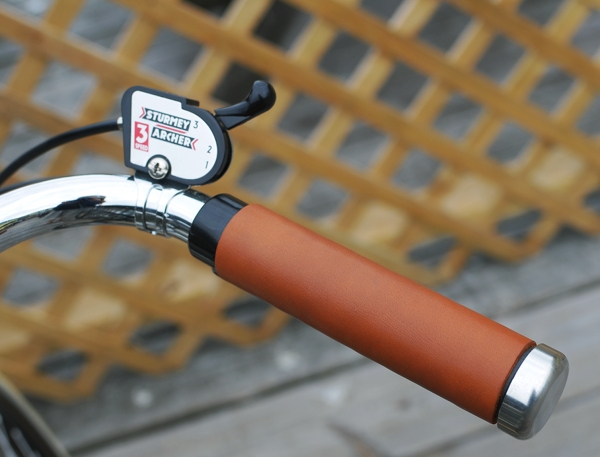 On bicycles with internally geared hubs, we typically see two types of gear shifters. The trigger shifter (pictured above) is a small gadget with a lever that is moved up and down. Today, this style of shifter usually accompanies Sturmey Archer hubs (though in Europe I have seen some lesser known models as well).
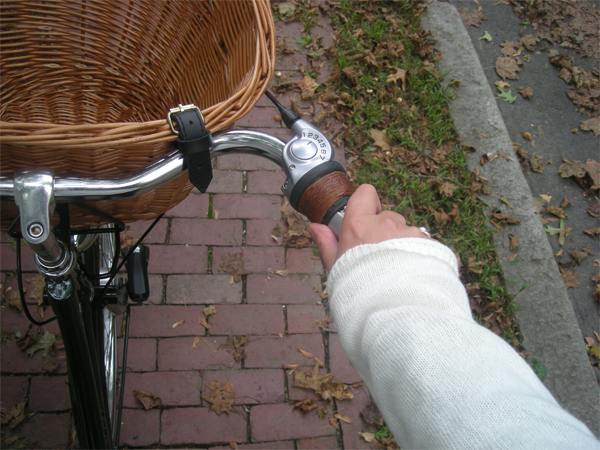
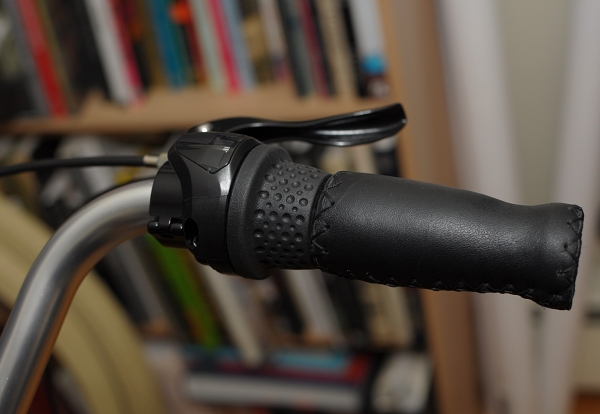 The twist shifter (pictured above) is a plastic and rubber enclosure that is built into the handlebar grip itself. To switch gears, you grab the rubber part and twist forward or backward. This style of shifter usually accompaniesShimanohubs.
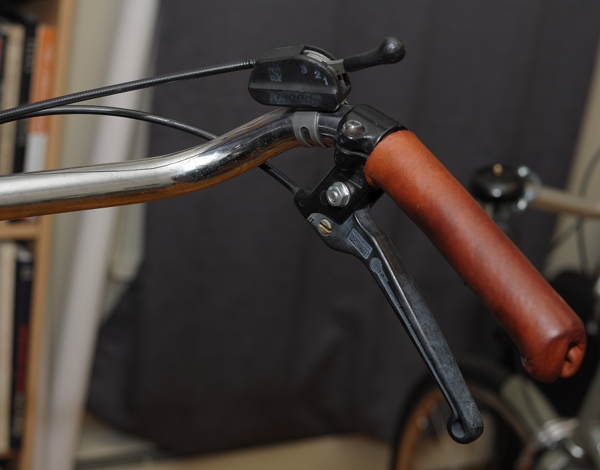 After using both types of shifters on various bicycles I've owned to more or less the same extent, I have developed a strong preference for trigger shifters. When I tell people this, they tend to assume it has to do with "vintage aesthetics" - but actually, it has to do with comfort. A trigger shifter takes up very little space on the handlebars, as it is attached with a narrow bracket. This means that the shifter does not interfere with the gripping area, and allows me to install full-length grips on the handlebars.
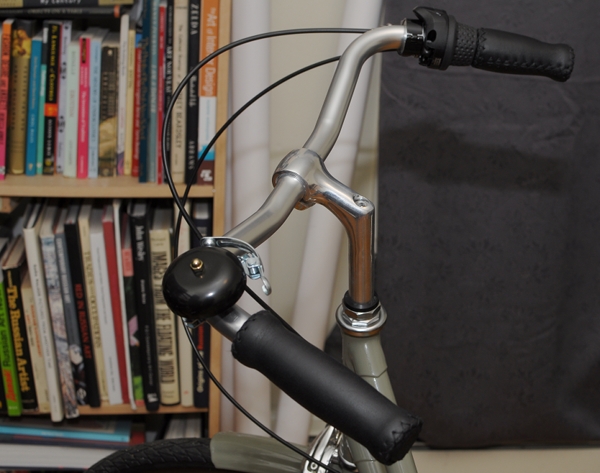 By contrast, having a twist shifter installed effectively cuts your gripping area in half. Notice that the right handlebar grip on the Bella Ciao above is shorter than the left grip - necessary in order to make room for the shifter. Granted, you can also keep your right hand on the rubber portion of the shifter itself - but it's not very comfortable, especially as there is a tactile break between where the real grip ends and the shifter begins.
 But why is it important how long your grips are, as long as you are able to fit your hands on them? The reason, is that having room to move your hands around on the handlebars, even a little, can be essential for hand comfort - especially on long rides. If you ride your bicycle for just a couple of miles or so at a time, then you might not get the urge to move your hands around. But the longer your ride is, the more fatigued your hands will get if you keep them in the same position. Some people are more sensitive to this than others, and those who have nerve damage in their hands (like yours truly) are particularly prone to it. The feeling can range from numbness, to "pins and needles" to a more severe sensation of electric current running through the hand. It is not good to experience this problem, and having room on the handlebars to move your hands around allows you to avoid it. Long gripscan also help you switch between a more relaxed and a more aggressive position on your bike (by holding the grips further forward or further backward) - giving you some added control over speed.
 Getting back to shifter styles, here is my right hand on the shortened grip that is integrated with the twist shifter on my Bella Ciao. As you can see, my hand covers the entire grip, with no room to move around - unless I place it on the shifter itself, though even then it is limited. And I had the same problem with this shifter on my previously-owned Pashley, which came with the 7-speed Shimano hub I innocently selected.
 On the other hand, here is my hand on the grip I installed on my Gazelle. As you can see, there is room for another handful - which is only possible because of the trigger shifter.
 I will note that one benefit of the twist shifter, is that it is more integrated with your hand position - which can be a plus if you switch gears very frequently. But on bicycles with internally geared hubs - especially 3-speeds - I have found that I tend to stay in one "ideal" gear most of the time, switching to a lower gear only when going uphill, and switching to a higher gear only when cycling very fast or downhill. Having to reach with my finger to pull the trigger has not caused me any inconvenience in comparison to using the twist shifter. Your experience, of course, may differ.


