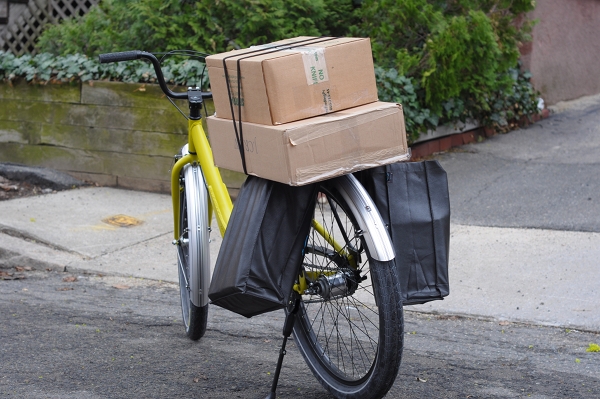
There comes a point in every bicycle blog's existence, when the author feels compelled to show off how much stuff they can carry on their bike as part of some errand for which one might normally use a car. If you think about it, it's impressive that I've held off for this long, so do give me some credit. But I am, after all, only human. And so, my time has come for the self-congratularoty "cargo hauling" post. Keep reading or close your browser in disgust, as you please - but yeah, it will be one of
those.
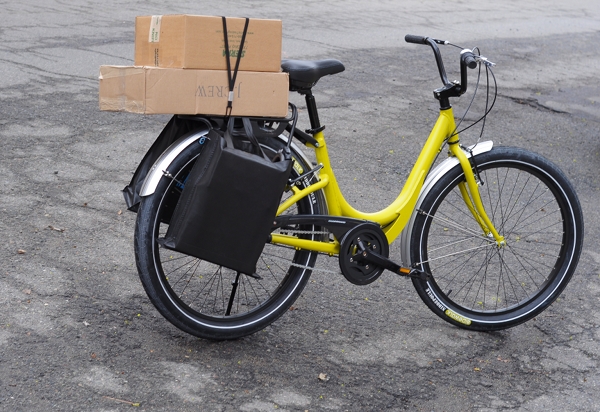
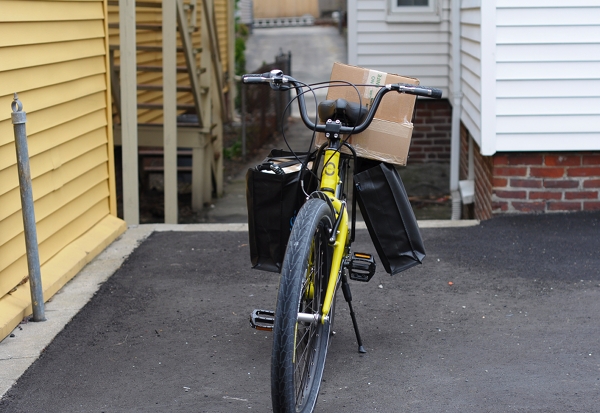
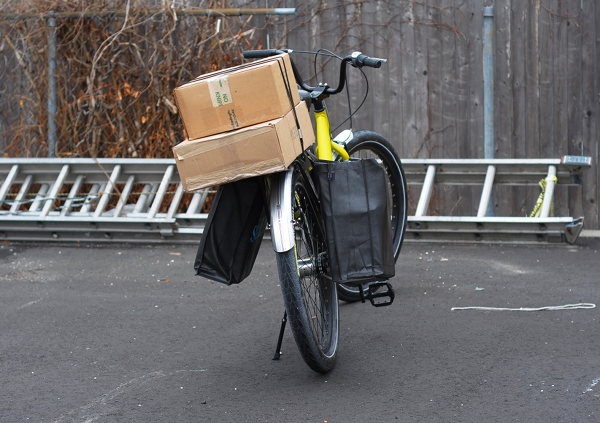
First, allow me to acknowledge that my so-called "cargo" pales in comparison to the likes of what some greater, more adventurous cyclists carry on their bikes every day without batting an eye. But I am neurotic and risk-averse, and I never really have all that much to carry. So for me, this was a great feat worthy of glee and merriment. To give you a sense of scale, the larger box with the
J. Crew insignia (I re-use old boxes for shipping) originally contained a long winter overcoat and is almost twice the length of the rack supporting it. The box on top of it is shorter, but taller. And each of the bags on the sides contain two heavy, medium-sized boxes.
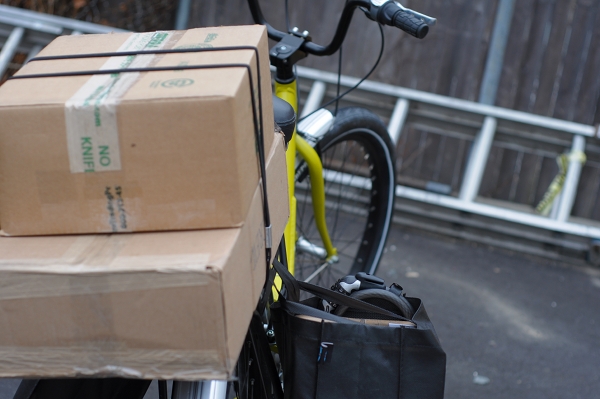
The trip was necessitated by my needing to mail a number of large packages simultaneously, which has not happened in a while. If confronted with this situation 5 months ago, I would have simply waited until the Co-Habitant was available and we would drive it all to the post office on a Saturday morning in the car. But now we no longer have a car (at least for the time being - it's not permanent, really!), so I could either make multiple trips to the post office or try to fit it all on my bike at the same time. The latter turned out to be surprisingly - almost disappointingly - easy. Within minutes of deciding to try it, the packages were secured to the sturdy backside of the
Urbana bike.
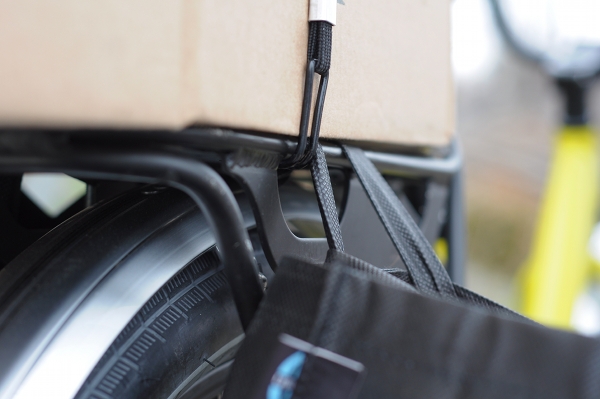
I wasn't sure whether my bungee cord would fit around both boxes, and whether it would be sufficient to keep the boxes sturdy. To my delight, it was a "yes" on both accounts. I secured the two bags on the sides using the rack'shook system (see here and here), which was convenient in that I did not need to use dedicated panniers or ropes. The whole set-up literally took 5 minutes, and then I was off: first gingerly, then at a moderate pace. The postoffice is fairly close to my house, so I cannot boast a grueling ride over hills or along dangerous highways. But for what it's worth, it was raining, and the roads in my neightbourhood are riddled with potholes the size of ditches.
The ride was an uneventful success. Still, I cannot say that I
enjoyed cycling with six boxes attached to my bike. I was conscious of them the entire time, and kept worrying that something might fall off - not only getting damaged in the process, but also causing me to panic and do something unwise in the midst of traffic. So... while I can do it if necessary, I am just not one to derive pleasure from loading my bike up with a stack of boxes secured to the rear rack with bungee cords.
On the other hand, I do like the independence such hauling capacity offers, as well as the smooth handling of this particular bike despite the load. Richard Masoner of
cyclelicio.us sent me a link to this picture of himself riding an
Urbana with an enormous plastic tub bolted to the rear rack, in which he carried 80lb worth of camping gear. Okay, I like it. If this bike were mine, I can see turning it into a dedicated "cargo chariot," with a colour-matched tub permanently attached to the rack. Postoffice run? Toss the packages in the tub. Need to buy furniture or building supplies? Tub! This could seriously eliminate our need for using a car for local errands, without the need for an unwieldy longtail or Bakfiets.
The Co-Habitant cautions against the giant tub idea, pointing out that carrying a heavy load that high is bound to create handling problems. But I wonder whether that applies to all bikes, or whether the
Urbana's design accommodates it - after all, the rack is rated for 150lb, and they do not specify that it needs to be carried as low as possible...
So, how about this question: Assuming that (1) one does not plan to transport children, and (2) the rear rack is rated for the weight, what, if anything, is wrong with attaching a Bakfiets-sized container to the rear rack of a hardy transport bike and turning it into a "cargo chariot"? I am not talking milk crate, but a truly enormous tub, as shown here. It seems to me that such a system could really work for a person who cannot deal with (or afford) a longtail or full-on cargobike. It could work for me, for sure.


 The other day I was cycling on a busy road where the city has recently installed those raised-platform intersections to make the cars slow down before crosswalks. Ahead of me, I saw a cyclist brake just as she entered the intersection - probably hoping to reduce the impact of the bump. Watching her, I somehow knew what was going to happen next and winced. And then it happened: As her wheel hit the raised platform, her bicycle flipped over, and she with it. All this occurred at a slow enough speed, so that she wasn't hurt and was soon back on the bike. But I suspect that she has no idea why the fall happened, which means that it might happen to her again.
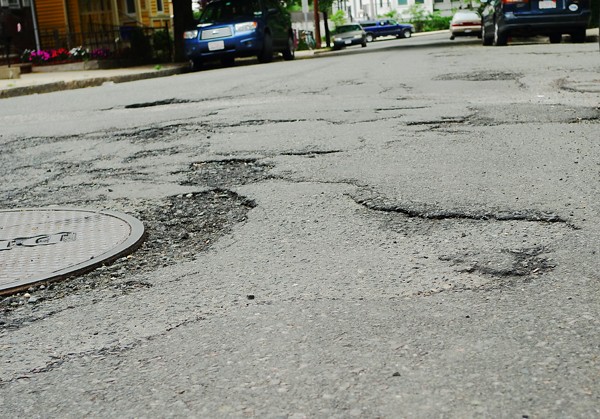 To me, it has always seemed self-evident that it is "bad" to brake while going over bumps, and watching the cyclist's fall confirmed that. But were there actually any facts behind this belief? I got home and looked it up, stumbling upon Sheldon Brown's explanation.
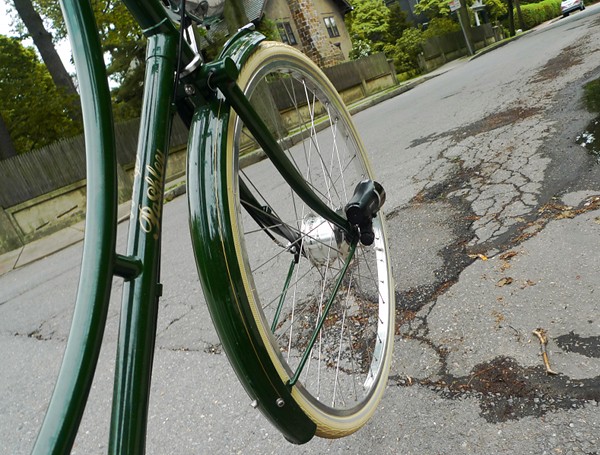 When we find ourselves hurdling towards an obstacle n the road that we cannot avoid, naturally the reflex is to slow down. But this should be done before going over the said obstacle, not during. Braking is your friend, but only when done correctly (brake before the bump, then release before going over it). I would also venture to say that most casual cyclists who use handbrakes do not differentiate between front and rear.
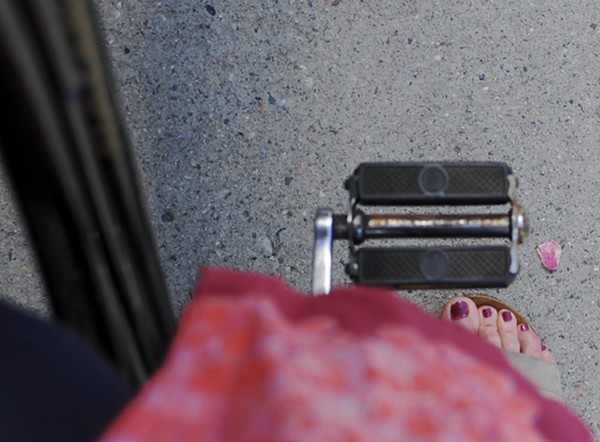 Of course, this is just one more reason why I love coaster brakes for cycling in the city. If you're used to braking with a coaster brake in order to slow down, you do not rely on the front brake as much and are not likely to squeeze it while going over a bump. I know that some will not agree with me on that one, but that is how I see it, and the coaster brake has been a reliable ally for me in pothole-ridden Boston Metro.


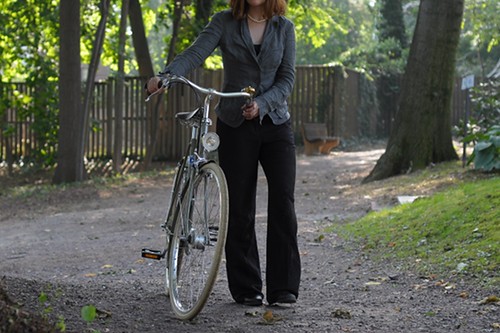 One question I am often asked about cycling to work, is how to avoid wrinkles on business and formal attire. I don't have many pictures of myself dressed up, but I do cycle in suits and dresses that fall into the business/ formal category. And rather than avoid wrinkles, I tend to choose clothing that either doesn't wrinkle easily, or that is meant to look wrinkled. This habit is a hold-over from a life of constant travel combined with a hatred of dry-cleaning and ironing boards, and it lends itself well to cycling. Here are some suggestions I can make from personal experience.
 I am also a fan of "twist-dried" designs. There may be a formal name for this process that escapes me, so someone please help me out. But what I mean is that there is a style of shirts, skirts, even evening dresses where the wrinkles are part of the garment's very design. This is achieved by drying the article of clothing in a wrung-out, or twisted manner. The resulting wrinkles are clearly intentional. They add a sense of structure and the illusion of subtle colour variation to the fabric once it is dry. Typically, the twist-dried effect is produced by the manufacturer, but you can create it on your own by simply drying any shirt, skirt, or dress (crisp cottons and silks with no pockets work best) in this fashion. Having wrinkles as an inherent design element of your outfit eliminates the need to worry about them.
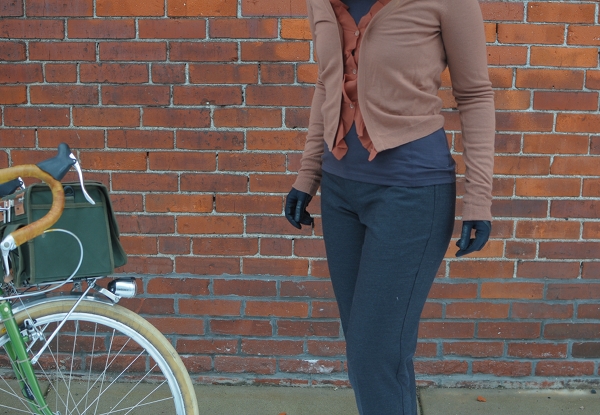 If your dress code limits you to more conventional suiting, I have found that wool skirts and trousers tend to be more forgiving as far as wrinkling goes than other fabrics. They still wrinkle, just less so. Not getting on and off the bicycle saddle every time I stop (but leaning the bike and putting a toe down instead) has been helpful in preventing wrinkles from forming as well.
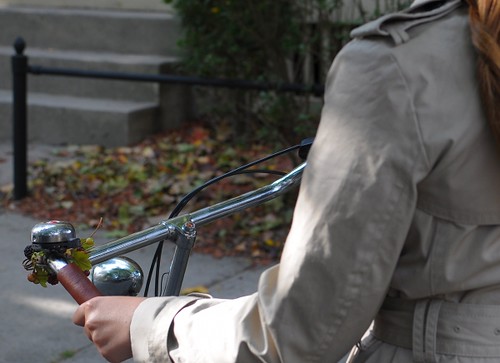 One last suggestion I can make for those whose clothing is wrinkle-prone, is to try throwing a coat on over the outfit. Granted, this works best in cooler weather, with stiff wool coats. But in warmer weather even a thin trenchcoat can be helpful.
 This is the fifth post in a series of unidentified photographs from the Charles Wiseman Family Bible. See this post for background information. Click on the "Mystery Photo" label at the bottom of the post to see all of the photographs in this series.



 Keeping in mind that in order for this non-morning person to play: I roll out of bed, dress, put in contacts and slap on a hat and go. Don't tell anyone, but these are my PJ bottoms this day. I must have gotten lost in the "dress" part of the routine. Nobody cares, they just care how you play! Or so I hope!
 Here is my favorite part of playing pickleball: the sitting down and resting and chatting! Especially when it is someone as sweet as Margie. Auburn, do you recognize the dog?
 Living the life in warmer Florida!

 watching the boats on the Charles river at twilight after a long ride...