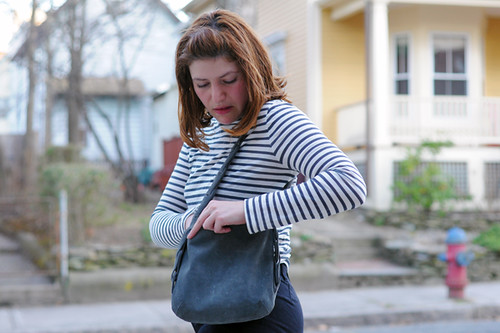
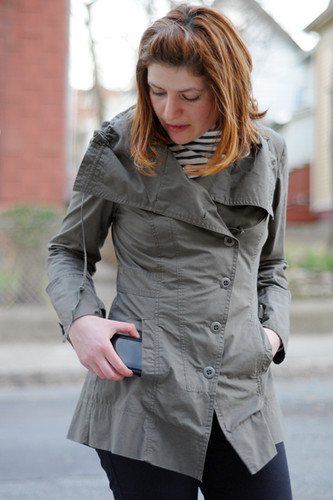
A couple of weeks ago, I had the pleasure of working withHeather McGrath - a woman whose excellent photos have graced many a magazine page and gallery wall. Those who love bicycles might also recognise her work from framebuilders' websites and cycling blogs: In recent years Heather has made quite a name for herself as a bicycle photographer.
In the course of running this blog and plunging deeper into the bicycle industry, I have thought about the relationship between cycling and photography. Many seem to get into photography as a result of riding their bikes. Perhaps it starts with wanting to photograph the scenery they encounter on a ride, or the bike itself. Over time taking pictures becomes a hobby and the rider's photography skills improve, sometimes to the point where they turn professional. Another scenario is where an established professional photographer becomes a cyclist, thereafter focusing largely on bicycles and cycling. Either way, bicycle photographers are almost invariably cyclists themselves. They have to be, to truly understand how to capture the defining characteristics of our beloved two wheel machines, as well as of those who ride them and make them. And Heather - as a daily cyclist, friend to local framebuilders and owner of a handbuilt bike - certainly understands all this. Ever wonder what being a pro bicycle photographer entails? I post a brief conversation with Heather below.

You describe yourself as an editorial photographer. In your own words, what does that mean?
I get hired mostly by magazines. But ad agencies hire me as well.
Roughly what portion of your projects would you say are bike-related?
A good portion. I have been very fortunate in this. I always marketed work that was directly related to my life. I just kept shooting for myself and the things I loved, and assignments started following. The bike industry has responded very well to my eye.
Do you recall who was your first bicycle industry client, or what was your first bike-related photo shoot?
My first shoot that got me anywhere was just of my friends who lived in LA at the time. I came out with my Mamiya 67 and just hung out and shot a few frames. Some of the shots ended up on my first promo which lead to my first assignment withBicycling Magazinea couple years later.
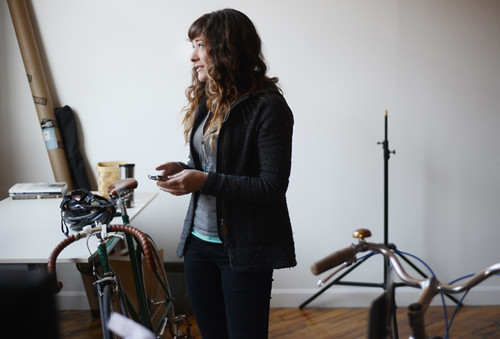
Do you get to travel for work? What sort of places have you recently traveled to?
I do. I have been flown to California, DC, Oregon, Austin, etc., for clients. I also travel alot for myself in pursuit of more photos for my portfolio. I actually just came back from a 7 week backpacking trip to the Netherlands, Croatia, Sweden, Norway and Iceland. I am going to start marketing these photos to travel companies and hopefully get more work there.
You've mentioned that for years you did not have a car and carried your photo equipment by bike. Can you describe your setup?
Thank god I have a strong back! Usually I just have my Bailey Works bag with a little subdivider in it with the body and two lenses. I don't light usually so I can travel light. But one time before zipcar existed I had a big shoot about 8 miles from my house. It was a big magazine and I was super nervous and of course it was about to rain right before I was about to leave. So there was no time to take the bus or anything. I packed up my huge Lowepro Trekker 2 bag which is supposed to be waterproof. I overpacked with lights and stuff I really didn't need because I was nervous. I threw in an extra set of clothes. attached a stand to one side of the bag and tripod on the other. And of course the downpour starts while I was en route. Like completely soaked to the underwear. And when I got to the house It had just stopped and this poor family had to open their doors to a girl who looked like a drowned rat with about 20lbs of gear on her asking to use the bathroom before we shot...
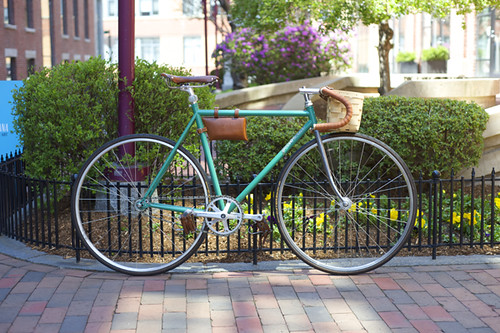
You own a beautiful handbuilt bicycle by Geekhouse. What made you decide to get a custom bike? Did you give the builder criteria as far as what you wanted in a bike?
Geekhouse wanted to make me a bike that was going to be a part of their NAHBS show bikes that year. Together we brainstormed ideas and colors. We all wanted something really classic looking. And my most important request was no toe overlap. I love track frames but I was sick of the toe overlap. A lot of the details of the bike were a surprise from the boys. They wouldn't even let me see it until it was completely done. I was there first curved fork and Brad made me my own monogram on the handlebars. I honestly think about how much I love that bike every time I ride it. I would never buy another bike that is not fitted to me.
[Note: See studio shots of Heather's bike here. Also: The basket pictured here does not actually live on the bike, just a joke.]

Are there any special challenges for you in photographing bikes compared to other types of photo shoots?
The hardest thing I have faced is keeping my shot in focus. I have all manual focus Zeiss lenses usually kept at f2.8 or lower and I'm often shooting motion or riding with the subject and have to have both hands on the camera and just look through the eyepiece to even see where I am going! You have to be able to stay on your bike, not hit anything, keep a good frame, and keep the person sharp! But I like these challenges. So I see it more as fun than torture. Another good story was when I was shooting the Lucus Brunelle shot for Bicycling Magazine. I had my assistant riding me around the city on a moped. I had no feet pedals, and makeshift belt keeping me and brad back to back. I just held on with my thighs and kept my feet in the air! We did this for about 2 hours. and the whole time manual focusing everything while we zipped in-between lanes of traffic at full speed. Luckily I grew up riding dirt bikes so I had no fear in any of this. We got really lucky though at the last shot when we found the police car that Lucas could skitch on. The police never looked over and it was hands down the best shot of the day!
Any advice for amateur bicycle photographers considering venturing into paid work? Do you think a formal education in photography is essential?
You don't need a formal education. I almost dropped out of my own photo school. I had already been a professional retoucher and a graphic designer before I decided to be a photographer, so I came into the industry already knowing the back end. But because of those skills I was able to keep retouching for ad campaigns while I was working on my photography career. Eventually I didn't need to retouch anymore. My suggestion is to sacrifice your social life while you work on your skills. Assist as many other people as you can. And shoot what you love. That's how I got here and I am very grateful.
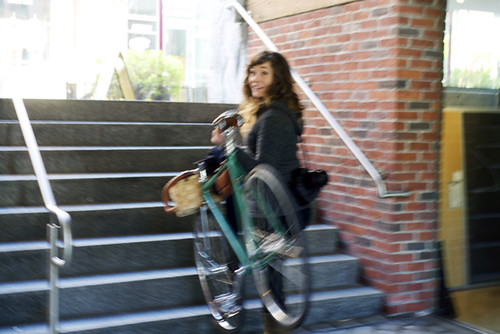
Having worked with Heather, I would describe her approach to photography as intuitive, fluid and thorough - focused on staging lively and realistic scenarios which can then be captured as still images. Heather uses both film and digital equipment. She prefers to ride fixed gear, and usually rides in her regular clothing and shoes, using pedals with toe straps. She commutes by bike around Boston, using her car when needed to transport props and large equipment. Whether working in her studio in Boston's South End or on location, Heather is good, really goodat what she does. And her taste in bikes is none too shabby either.

 3. Investigate the various services available for scanning photographs. Do they scan the pictures themselves or send them elsewhere? What is the turnaround time, cost, etc. The Genealogy Insider had a post on Batch Photo Scanning Services in October that I've used as the starting point for my investigation. I have negatives for nearly all of the pictures I've taken, so the negatives could be scanned or printed if the pictures were lost in this process. It would be costly, but not disastrous if something were to happen to these prints.

 What you see here is the Austrian Parliament building. The entrance is up on a big winding hill, and we decided that what better way to test the
 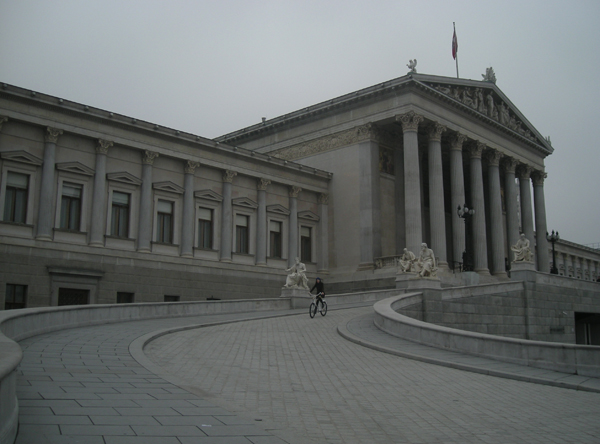 After briefly considering whether this was "allowed", we decided that such a trifling thing hardly mattered, and went for it. Anna went for it, that is - while I photographed her.
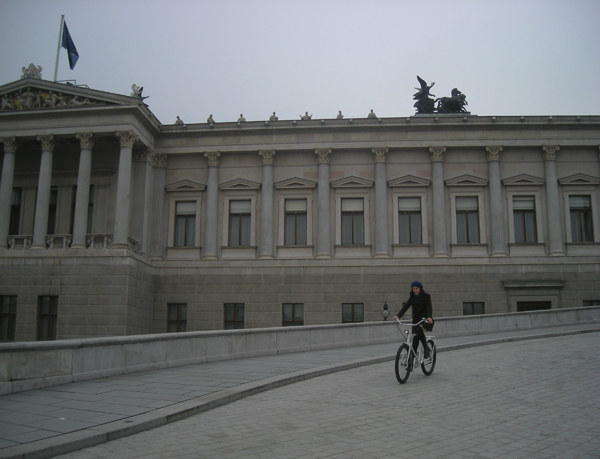 I mean, that hill looks like it was made for cycling, doesn't it?
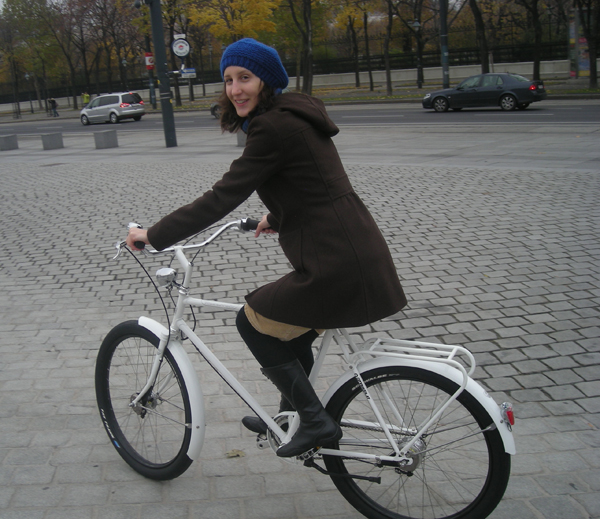 Upon making it back down, Anna reported that the brakes on the
  This heroic feat did not go unnoticed: We were immediately surrounded by a group of Chinese tourists, who were interested in the
  It was not clear what exactly about the bike appealed to the tourists: More than anything, they seemed to be interested in the headlight, but we could not understand each other as they spoke neither German nor English. We posed graciously for many, many photos, and finally parted ways.


 In preparation for the eventual acquisition of a handlebar bag, Graham has now been fitted with a front rack (Nitto M-18 from Renaissance Bicycles). I have been planning to purchase a front rack for a while, yet had no idea that there were so many choices and that the whole thing is so complicated.
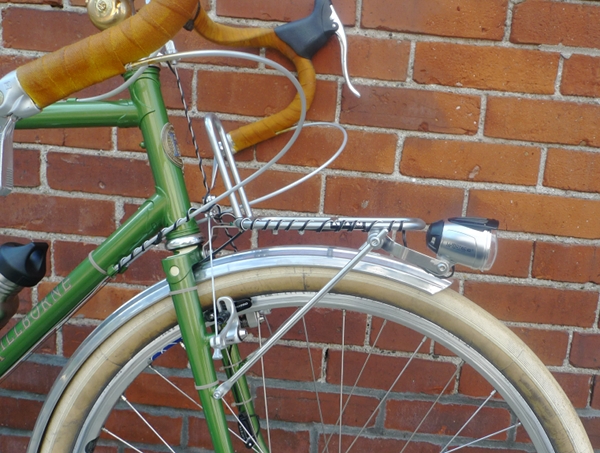 To determine which front rack your bicycle needs, several things must be taken into consideration:
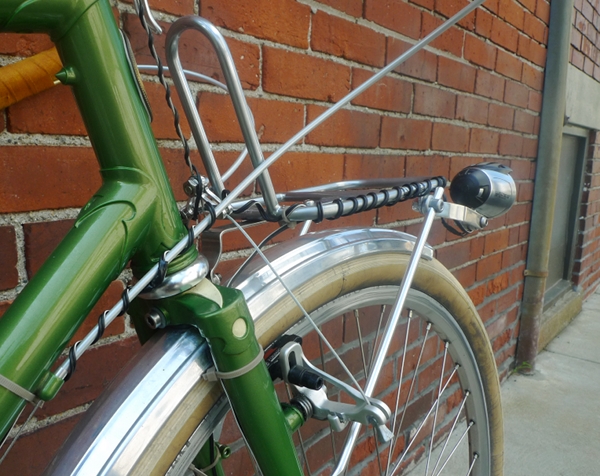 But wait, that is not all: You must also consider your brakes. Even if the rack you choose does not mount onto the brakes themselves, it can be incompatible with a given type of brakes (in particular, cantilevers) due to clearance issues. Don't forget to check up on this!
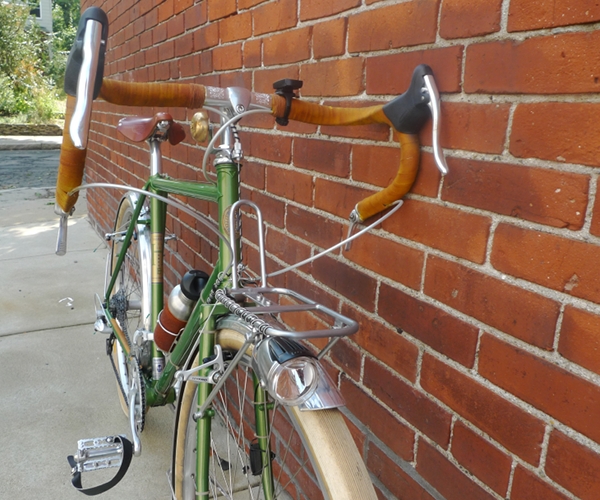 Exhausted yet? I feel spent just writing about this! And I haven't even raised the question of aesthetics yet. If you look at the front racks closely, you will notice that some are square (like the Nitto M-18 in my pictures), while others are round. If you have a rear rack installed on the bike, it may be important to you that the two match - in other words, that both are square or both are round. So that is yet another design element to watch for.
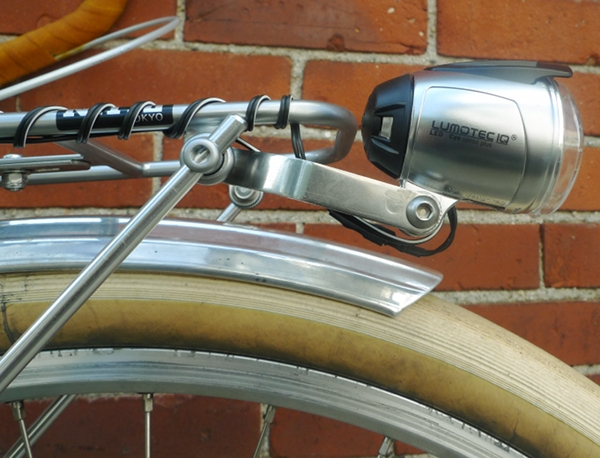 Last but not least, there is the question of light placement. Some racks are made with little braze-ons for mounting lights. The Nitto M-18 is not. So we bought a VO light mount - which is basically a small metal bracket with two holes. The size of the holes was not compatible with either the rack's or the headlight's bolts, so we had to drill them out.
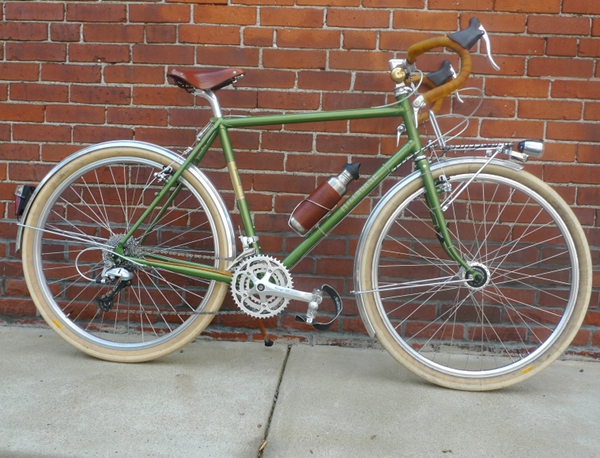 I am also not sure how I feel about the garlands of wiring that now seem to cover the bicycle's front end like ivy. Once the handlebar bag is installed the wires on the rack will not be visible, but what about the section that curls around the shifter cable? All in all, I cannot say that this set-up can be called "elegant" and we are still considering alternatives. One thing I do like, is how far forward the light extends - this placement seems ideal for road illumination. Is it a matter of compromise, or is there a magical solution out there that I am overlooking?
 We have successfully re-routed the wiring, so that it now runs straight underneath the rack instead of coiling around it.
 We have also titled the bracket down, placing the headlight a little further back, which should reduce the vibrations. I will remove theNittosticker when I get around to it.
 "Aerial" view.
 The wires are considerably less noticeable this way, and I think the results are good. Thanks for everybody's comments and suggestions.
 Each morning the beauty of the morning glories help me get started on another day. I have about 4 different areas where there is hundreds of blossoms each day. Sadly they are all gone by evening but I know another group of them will be there to greet me the next morning. I love this blue color but also have other shades of blue and some purple. Morning glories have always been one of my favorite flowers not only because of their beauty but because they are so easy to grow. They are an anual and do have to be replanted each spring but grow fast, with little fertilizer and not as much water as a lot of other flowers. One group decided to grow up into my Bradford Pear tree. A Bradford pear is an ornimental pear meaning it has beautiful white flowers in the spring but no fruit.
 Oh how the raindrops do glisten on that chrome ding-dong bell...
 and on the Sturmey Archer 5-speed hub...
 and on the Brooks Glenbrook bag...
 Brooks saddles come with this convenient rain cover. Don't know whether I think they look cool or perverse! Either way, I am completely envious.
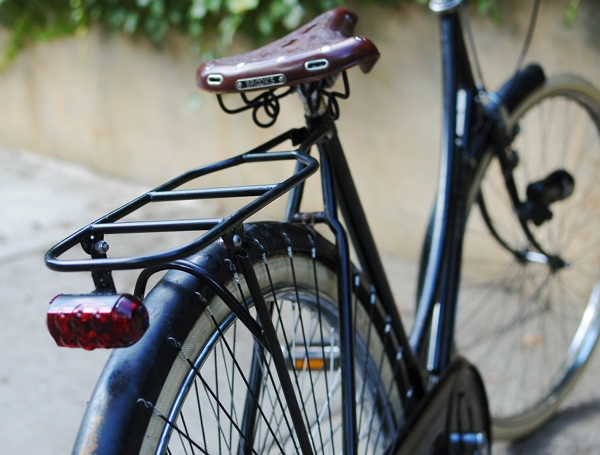 For the past month, I have been working on a rear rack prototype for the Bella Ciao "Superba" (which will look nothing like the Roadster rack above), so racks have been on my mind lately. I've been checking out the racks on practically every bike I see, and also paying attention to how I typically use mine.
  In addition to how much stuff I carry on the rear racks of my bicycles, I have also been trying to note in what ways I find them convenient versus not. For example, I often lament the lack of bungee cord attachment points on my Gazelle's rear rack. Also, not all racks are compatible with all pannier attachment system - the spacing of the slats on some racks can interfere with the spacing of the hooks. What major complaints, if any, do you have about the rear rack on your main transportation bicycle? You can select multiple items on this one: