
(Photo: Just over the big roof on pitch two of Alpine Diversions (5.8).)
As I've worked my way through a bunch of 5.9 routes at the Gunks this past year, a certain route has been hanging out there in the background, taunting me. It is a two-star route that is supposed to be really good. It also happens to be the route on which I broke my ankle in : Insuhlation (5.9).
A part of me has really wanted to go back and climb it-- to slay the demon, as it were. To put it behind me. And to find out what I think of the route, two years later. Who knows, maybe if I climbed it now I'd find it to be no big deal.
But another part of me wants nothing to do with Insuhlation. I worry that I'd become a shivering wreck if I led it again; that I'd be so in fear of a repeat injury that it would become a self-fulfilling prophecy. And a repeat injury on Insuhlation would be absolutely ridiculous. I can't let that happen. I'd never forgive myself.
Perhaps the thing that makes me most wary of Insuhlation is that I don't really know why I fell off of it when I did. I am also unsure of whether I could have done anything to better protect myself. I recall a little roof, and a (wet) keyhole-like hold that I tried to use briefly while reaching for a chalked-up, bigger hold above that I thought would be a jug. I remember grabbing this jug and finding it to be not so juggy. I had a green Alien below the little roof and I was looking around for more pro (but finding none) when I went flying.
Did my hand slip off? Did my foot? Was there better pro available than what I had? I'd feel better about going for it again if I had answers to these questions.
I had a brilliant idea about halfway through the season. It suddenly occurred to me that I should have one of my partners lead the route, and then I could follow it. It is such an obvious idea, I don't know why I never thought of it before. I could, for example, send my reliable guinea pig Adrian (who seems always willing to lead anything) up there and then as a second I could suss out whether I thought I could safely lead it at a later date.
But then Adrian led the route with another partner before I had a chance to suggest it to him. It didn't seem right to try to make him go right back to do it again. Adrian's impressions seemed to be that the last bits of the route were totally straightforward, and well-protected too. Hearing this only deepened the mystery for me.
As the year came to a close and the climbing season extended into an unseasonably warm December, I came up with another idea. I decided to lead the route right next to Insuhlation, a 5.8 called Alpine Diversions. Dick Williams gives the route a single star and calls it "surprisingly good." It seemed worth checking out in its own right. And it goes very close to Insuhlation. The second-pitch crux roof is only a few feet to the right of the Insuhlation crux, or so I believed. I thought I could lead Alpine Diversions and get a good look at the exact place where I fell. I might even get some ideas for some placements I missed. Maybe it would help me decide whether to lead it again, and if I felt good on Alpine Diversions I could do Insuhlation immediately thereafter.
So on December 4 when I climbed with Liz I suggested we try Alpine Diversions. Liz was game to try it.
I thought both pitches were just okay. Each pitch has one interesting crux moment and not too much else to offer.
On pitch one the interesting moment comes right off the ground. The pitch follows a thin, steep vertical crack running a few feet to the left of a little gully. One hold, a sidepull, is easy to reach. A jug sits above. If you are tall enough to reach the jug from the ground, you will probably find the opening moves to be a breeze. If, however, you are short like me, you will have to boulder up to the jug. And this boulder problem is a puzzler. I don't want to spell it all out but I will tell you to look around to either side of the crack. I found another crucial hold off to the left which made all the difference for me. This hold allowed me to get on the wall and reach up to the jug. And once I had the jug, I threw in a piece and made another step up to find that the pitch was essentially over.
Dick Williams suggests in his description that you continue directly over a blocky overhang and then up to the belay ledge past the big pine in "the steepest way." What this all means (I realize in retrospect) is that the route is contrived. After the opening boulder move, there are ways to force yourself to continue making 5th class moves. But in order to do so you have to deliberately avoid easier climbing just a step to the left or right. I didn't really see the point. It just seemed silly not to scamper up the stair-like blocks past the tree to the belay ledge.
On pitch two, the main attraction is a rather large overhang. Nice moves up a corner take you directly underneath it. Then an easy move left might deceive you into thinking you've already escaped the crux. But no. You still have to move right and pull the roof. It is a big reach. I really enjoyed this crux move. And there's great pro at the lip of the overhang.
After the roof, you again have the option to force yourself to keep climbing. You can move left and up to another roof, this one smaller and dirtier (and from the looks of it easier) than the first. On the other hand, if you just continue straight up you are basically done. Some easy low angle moves will take you to the belay tree. I chose the easy way, again not seeing much point in contriving a harder path to the finish.
When I reached the top I realized that I had forgotten to look at Insuhlation! The roof on Alpine Diversions had captured my full attention. Once above the roof, I probably could have glanced over at the exact spot where it all went wrong two years ago. But as obsessed as I am, as much as Insuhlation haunts me, I still didn't think to do it.
I had already decided I didn't have the stomach for doing Insuhlation, anyway. But still I was bummed to have missed out on the chance to look over the route up close.
On rappel I attempted to scope it out. To my surprise, I couldn't spot the line at all. Maybe I was too far to the left, but I had no luck in finding it. I thought I'd immediately see the roof, the keyhole, the jug. But I saw nothing I recognized. It was baffling.
I'm pretty sure that if I ever get back to climbing Insuhlation the whole experience will seem new to me. I want to go try it. But I don't want to approach it in an unhealthy state of mind. I don't want to climb it to prove anything. I don't want to climb it all stiff and scared. I think the whole accident thing is still too much in my head, even two years later. Better to wait.

 Valles Caldera. The Caldera, Spanish for when a volcano blows and then falls in on it's self, is about half way between Jemez Springs and Los Alamos, New Mexico. For many, many years we have driven by here on the road seeing only the part that can be seen from the highway. From the mid 1800's to the year .. it was a private ranch owned by several different families. In .. the US Government bought it to make it into a big national park. Over the past 13 years the government has continued to run it as a ranch and let biologist, geologist, and many other 'logist type scientist onto the ranch to see exactly what is there. Not only did two big volcanos explode here but several smaller ones making it a very unique landscape. Because of the volcanos there is still a lot of geothermal activity in the area even though the volcanos are considered extent. We didn't know it but recently a Visitors Center had been built and the road to it is now open for people to come in a see part of the Caldera. Most of it can only be seen if you get special permits for hiking or take one of the bus tours that are run frequently.



 Hopefully these daylight pictures of Jacqueline will do her more justice than the blurry ones from the previous night. These were taken yesterday in my courtyard. I rode her around Vienna all day in a state of disbelief. She rides wonderfully and the folding basket-panniers are amazingly functional. It does not matter what I am wearing, what I am carrying, and where I need to go - this bicycle is ready for anything.
 As mentioned previously, Jacqueline is a lady's Steyr W
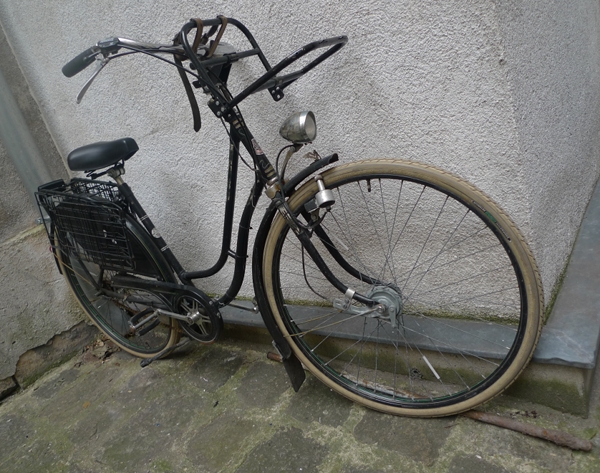 Jacqueline is a 1980s model, though its components are from a variety of time periods. The frame design is a "swan frame": The downtube curves around the front wheel and the top tube forms a complimentary curve. Put together, they form a "swan's neck" shape.
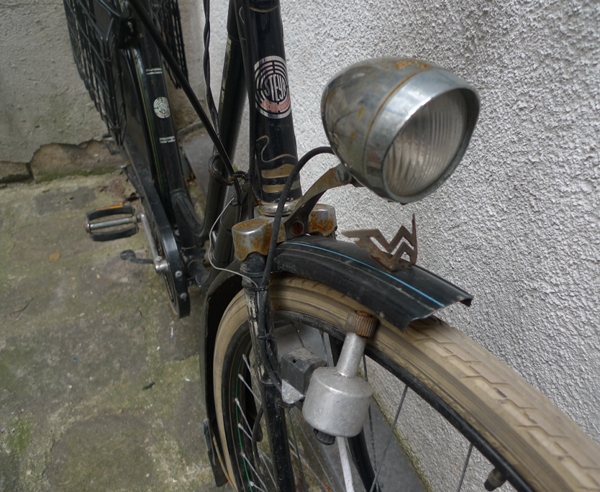 To my eye, the lugwork on the headtube resembles swan as well, though I may be imagining things.
 Lugged connector between the downtube and the toptube.
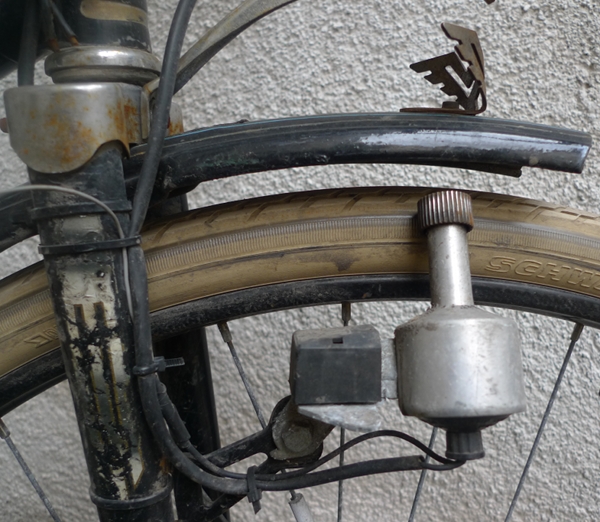 Is the bicycle equivalent of "hood ornament" a "fender ornament"? This bike has one in the shape of a wing-like art deco "W" - appropriated from a German Wanderer bicycle.
 The beautiful tear-drop tail light. I very much want one of these for one of my bikes. You can see the little wire coming out from under the fender and running along the rusty stay, zip tied to it. The winged "W" logo is once again from a Wanderer, though the fender itself is native. Notice the holes that have been drilled into the fender for the original dressguards. You can also see the double kickstand (I prefer this one to the Pletscher) and the rear coaster brake hub. It is not a Sturmey Archer; in fact I saw no markings on it at all.
 The coaster brake functions extremely well, but the front (hub) brake is mostly decorative - It works when you're stopped at an intersection and want to prevent the bicycle from rolling forward, but doesn't really make an impact when the bicycle is in motion. The coaster brake is plenty though, and I quickly got into the habit of simply ignoring the front brake lever. The hub gears are operated via the "Torpedo" shifter. The gears are widely spaced, similar to the
 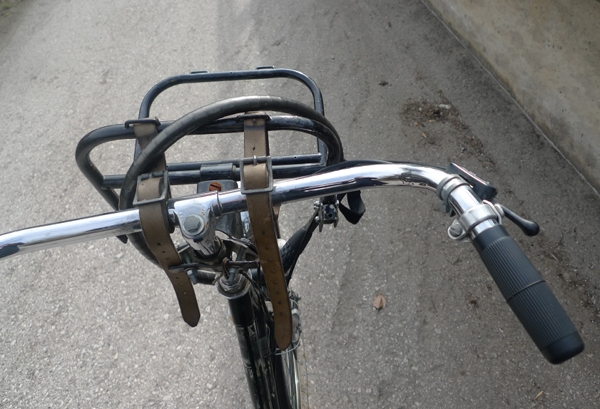 The handlebars are what people today usually refer to as "Porteur" style, but actually they are similar to the version of North Roads that are put on
 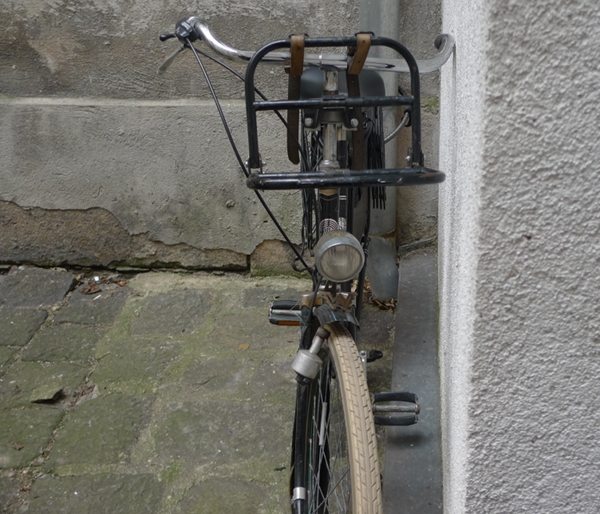 Here is the view from the front, with the rack unfolded. The rack is bolted to the stem and strapped to the handlebars with aged leather belts. It is not supported enough to carry heavy loads, but it is a convenient place for things like extra layers of clothing that might be removed and then put back on during a ride.
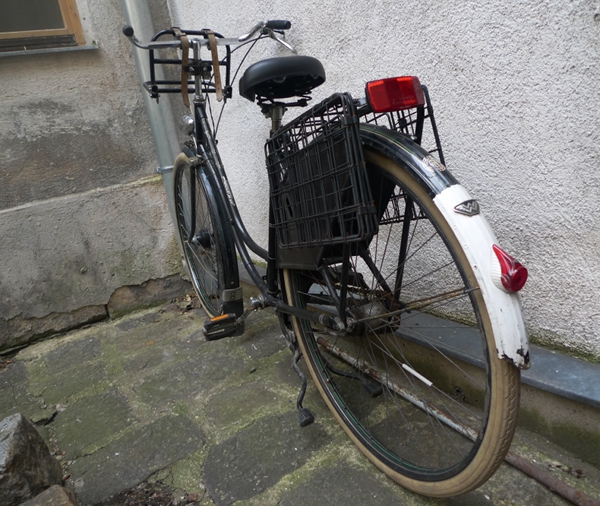 The rear basket panniers, on the other hand, can pretty much take anything you want to put in them. My large work bag fits into these perfectly, as do grocery bags (2 in each). The ride quality is hardly effected when the basket panniers are loaded. I think I need to install these on one of my bikes. The tires are 28" cream Schwalbe Delta Cruisers, just like on my Raleigh at home. They roll fabulously and swallow cobblestones without a peep - wonderful.
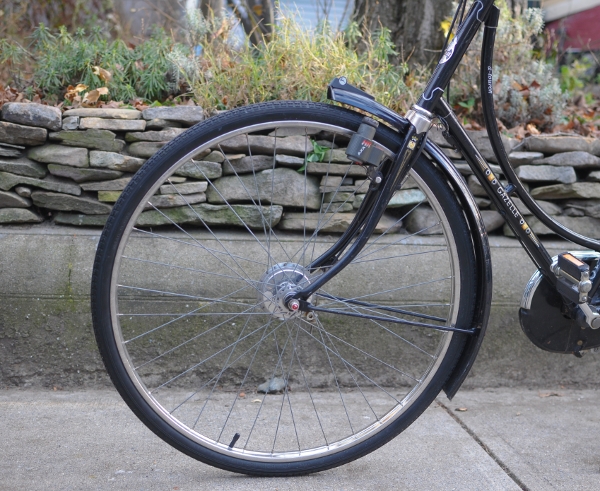 The phrase "fork's bent" has become a private joke of sorts in vintage bicycle circles. Almost any time somebody posts a picture of their "awesome vintage find," there will be that one person who comments that "the fork looks bent." Most of the time, the fork is not bent and it's just something to say - or maybe the angle or the lighting in the picture are misleading. Nonetheless, the possibility of a bent fork or frame is certainly something to watch for in vintage bikes. If a bicycle is steel, a bent frame or fork is not necessarily tragic - steel is flexible and the bent portion can usually be straightened. Cracks, on the other hand, are of greater concern.
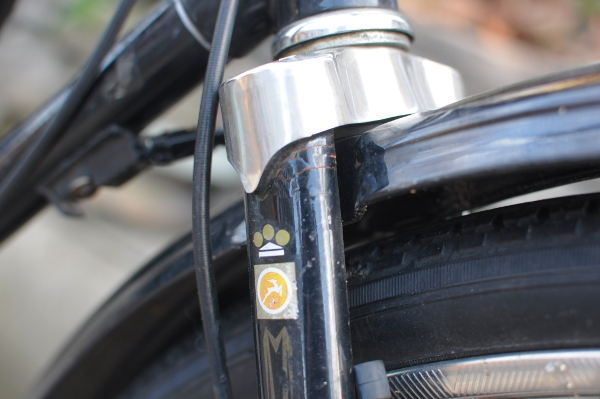 During my visit to Geeekhouse last week, the guys were looking at my Gazelle and pointed out that the bits of cracked paint underneath the fork crown could indicate cracks in the surface of the fork itself. Needless to say, my heart sank.
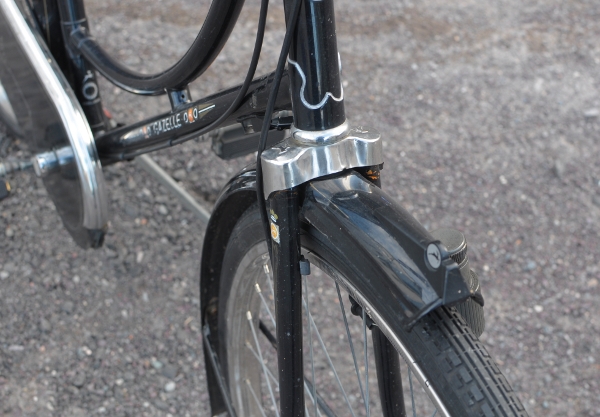 I noticed the cracked paint before, but didn't think anything of it. The fork blades in of themselves are not deformed and there are no indicators that the front end of the bike has been in a collision. In an impact strong enough to bend the fork, surely there would have been some other damage - but there is not a scratch anywhere. The bicycle also handles absolutely fine - better than fine - with no indication of anything "off" in the steering.
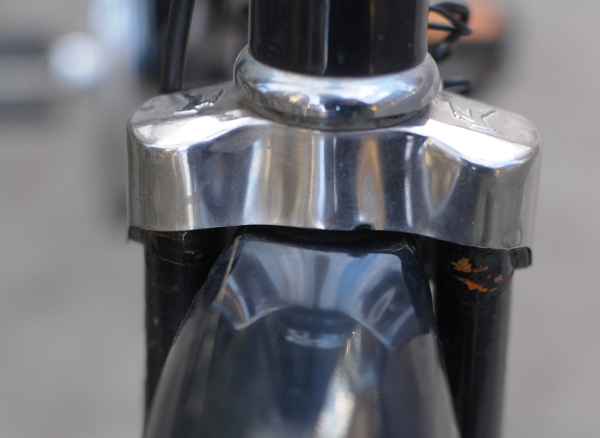 It would be easy to dismiss the cracked paint, if it were not for one red flag: The cracks are symmetrical - right underneath the fork crown, on both the right and the left blade. How did they get there, and how can we tell whether it really is just cracked paint or an indicator of some sort of trauma to the fork?
 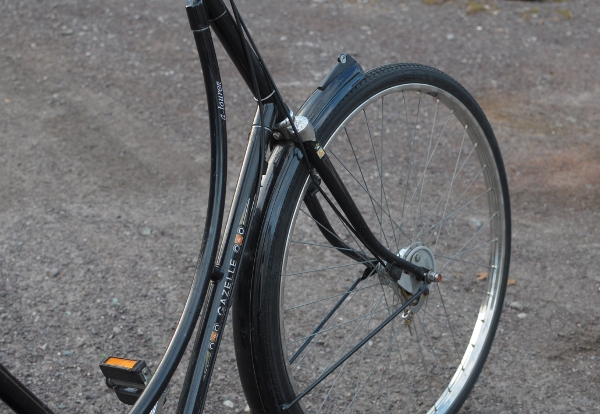 I was speaking to a local frame-builder yesterday, who advised to check for similar paint cracks in the back of the fork blades. There are none; the paint is cracked only in the front. To him, this was an indicator that the fork could be fine - as stress fractures typically happen in the back and not in the front of the blades. He also pointed out that even if the fork has been bent and reset, or even if there are hairline cracks, a massive Dutch fork like this can probably take it, without it being a safety issue. No doubt there are loads of people in the Netherlands riding ancient beaters with visibly bent forks.
  I would definitely describe Vienna as a "cycling city" in term of its infrastructure. There is a good network of bike lanes, a bike share programme, many cyclists on the streets, and a decent system in place for integrating cycling with public transportation. All the more frustrating to be here bicycle-free! For a number of reasons, it was not practicable to either bring my own bicycle here or to rent one. I will express my Bike Rental Lament in a separate post. But for now, I give you a few images of night time Vienna - on foot.
 For the purposes of sight seeing and tourism, this is not the best time to be in Vienna, as it is in between seasons. Scenic Autumn has ended, while the
  In some parts of the city center, the famous Viennese Christmas markets have already been set up. Those are the little lit-up tents you see in the foreground of the church.
 Inside one of the tents. The Christmas markets sell everything from traditional foods and handmade toys, to Christmas decor, leather goods, and clothing.
 Here is a stand with sausages and Glühwein (mulled wine).
 A vintage roadster graces the cover of a detective novel.
 For those with a fetish for fine gloves and tights (you know who I speak of, ladies!), being in Vienna around this time is especially difficult: lots of fine products by local designers are on offer. Thankfully, the high price of these prevented me from buying them - even if I did try to justify it to myself as a "cycling expense". No no no.
 A traditional Viennese café: marble, dark wood, red velvet upholstery, dim lighting, waiters in crisp black and white, tiny silver trays, sugar cubes in crystal bowls, the works! If you have a chance to visit Vienna, plopping yourself down in one of these after a day of walking (or cycling) around the city, is a real treat.
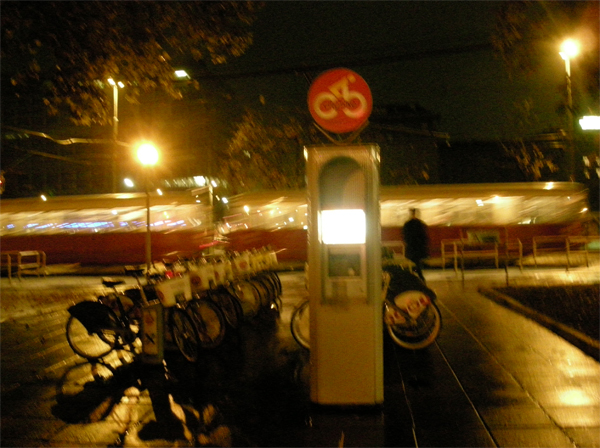 I leave you now with an image of a Vienna Citybike station. Not many takers at 5:00 am!